
Why water testing matters in Sunshine Beach
Sunshine Beach is largely on town water, but most homes here still keep a rainwater tank for the garden, the beach-rinse outdoor shower, or to top up the pool — and a number of older Sunshine Beach houses retained the original tank that still feeds at least one internal outlet. We focus only on those self-supplied parts of your supply, because that's where the localised coastal risk profile shows up. Sunshine Beach sits directly on the ocean, and ocean-aerosol salt, fine sand, pandanus debris and intense UV all act on tank catchments here in a way they don't act on inland properties.
Local context: Sunshine Beach catchments take direct ocean-aerosol salt loading, especially on Belmore Terrace and Park Road blocks closest to the foreshore. Pandanus, screw-pine and coastal-banksia debris also accumulate in tank inlets more quickly here than on inland properties.
Likely water sources in Sunshine Beach
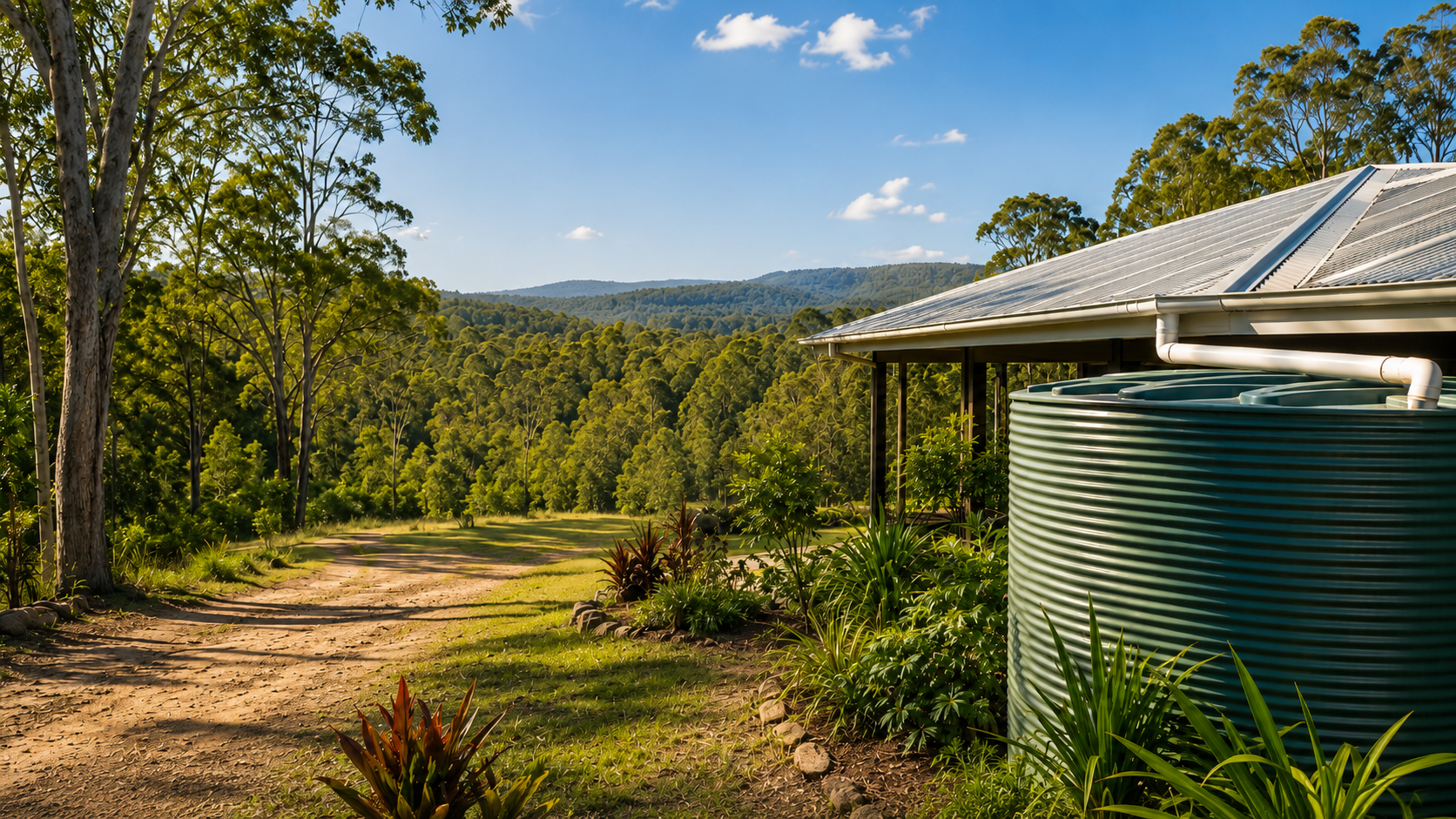
- Rainwater tanks plumbed to the garden or outdoor shower on most Sunshine Beach homes
- Tank-fed beach-rinse and outdoor entertaining taps on Belmore Terrace and Park Road blocks
- Mixed tank + town-water systems on long-held Sunshine Beach houses where the original tank was retained
- Pool top-up tank lines on coastal homes that capture roof rainwater for the pool
Common local water concerns
- Direct ocean-aerosol salt loading on tank catchments closest to the Sunshine Beach foreshore and headland
- Pandanus, screw-pine and coastal-banksia debris accumulating in tank inlets along Park Road and Belmore Terrace
- Wind-driven sand fining onto Sunshine Beach roof catchments during onshore weather events
- Tank lines feeding outdoor showers near the surf staying salt-loaded between rinse uses
- UV-degraded inlet screens and first-flush hardware on tanks left exposed to direct coastal sun for long periods
Recommended test packages for Sunshine Beach
Based on the typical water-supply profile and property mix in this suburb. You can also mix and match samples — e.g. one tap and one tank — on a single booking.
Sample collection & drop-off
- Use a sterile sample bottle (we supply one when you book).
- Keep your sample cool and out of direct sunlight after collection.
- Bacterial samples must reach the lab within 24 hours of collection.
- Drop-off: 1/37 Gateway Drive, Noosaville QLD 4566 — Monday to Thursday before 2 pm.
Sunshine Beach is approximately 15 minutes by car from our Noosaville lab at 1/37 Gateway Drive. Drop-off accepted before 2 pm Monday to Thursday — bacterial samples must reach us within 24 hours of collection for accurate E. coli and coliform analysis.
Local FAQ — Sunshine Beach
Our Sunshine Beach house runs mostly on town water with one tank that feeds the outdoor shower. Is that worth testing?
Yes — outdoor-shower tank lines, especially ones near the surf, often hold a slug of warm, salt-loaded water between uses. That's a common cause of off-smells and elevated bacterial counts on first use. A Basic Water Safety Check is the right starting point for a single tank-fed outlet.
We catch rainwater into the pool — should that water be tested too?
If the pool is in regular household use, yes — the rainwater going in determines what your sanitiser has to manage. The Essential Tank Water Test covers the bacteriology and the chemistry (pH, conductivity, turbidity) that matter most for pool top-up sources at coastal sites like Sunshine Beach.
Our older Sunshine Beach home still has an internal tap fed off the original rainwater tank. What test fits?
If a tank still feeds any internal outlet used for drinking, cooking, or washing, step straight up to the Essential Tank Water Test — it's the broader package, covering microbiology plus the chemistry that matters for coastal catchments where salt, fine sand and pandanus debris are routine considerations.
Does SCWT certify Sunshine Beach holiday rentals for compliance?
We're an independent water testing lab — we provide a plain-English Certificate of Analysis for the rainwater tank and any self-supplied outlets on the property. We don't issue holiday-let compliance certificates or tenancy-law sign-offs. The report is something owners can share with their managing agent, plumber or insurer as supporting evidence of the tank's condition at the time of testing.
How long do water testing results take?
Most reports are usually returned within 1–3 days, depending on the test package, sample timing and lab workload. Bacterial tests (E. coli, coliforms) start the day your sample arrives at the lab.
What's the difference between a Basic test and an Essential test?
Basic Water Safety Check ($79 prepaid, was $99) screens for E. coli (Positive/Negative) and Total Coliforms (Positive/Negative) plus pH and Conductivity — answering the question 'is my water safe to drink?'. The Essential Tank Water Test ($143 prepaid, was $179) adds TDS, turbidity, alkalinity, hardness, cations, anions and metals — giving you a broader picture of your rainwater tank's water quality and overall system health.