Heavy Metals Testing Sunshine Coast: Is Your Water Safe?
What if that subtle metallic aftertaste in your tap water is more than just a plumbing quirk? If you've spotted blue-green staining on your sinks or worry about lead in your older Sunshine Coast home, you're right to want answers. These aren't just aesthetic concerns; they're signals that it's time for professional heavy metals testing. You deserve to know that the water your family drinks every day is safe, without having to guess based on smell or appearance alone.
We understand that laboratory reports can feel overwhelming, but we're here to provide more than just numbers on a page. This article explains how to identify toxic elements like arsenic or lead and, more importantly, how to fix the problem for good. You'll discover the simple steps to take after your analysis and how to secure long-term peace of mind for your household. Our goal is to provide local testing, clear results, and practical advice that actually makes sense for your Noosaville home or hinterland property.
Key Takeaways
- Identify how common contaminants like lead and copper enter your Sunshine Coast home through aged plumbing or local groundwater sources.
- Recognise the subtle warning signs of metal contamination, such as blue-green porcelain staining or a distinctively bitter taste in your drinking water.
- Understand why proactive heavy metals testing serves as a vital primary prevention strategy, offering peace of mind before health issues arise.
- Learn the simple two-step process to organise a professional laboratory analysis and receive a sampling kit tailored for your property.
- Discover how to interpret your results with practical advice that makes sense, moving beyond complex data to ensure your family's safety.
Understanding Heavy Metals Testing in Sunshine Coast Water Supplies
Is your tap water as safe as it looks? While most Sunshine Coast residents enjoy high-quality water, heavy metals often hide where you'd least expect them. In a domestic context, we focus on four primary culprits: lead, copper, arsenic, and cadmium. These elements don't just appear out of nowhere; they enter your home system through corroding copper pipes, old lead solder, or natural groundwater mineral deposits. Understanding what heavy metals are helps explain why they don't break down like organic contaminants. Instead, they persist in the environment and can accumulate in your body over time.
Local knowledge of the Coast's unique geology is vital for accurate heavy metals testing. The soil composition in the volcanic hinterland differs vastly from the sandy foundations of our coastal strips. We use the Australian Drinking Water Guidelines (ADWG) as our safety benchmark. These standards, which were updated as recently as 2022, dictate the maximum allowable levels for substances in your glass to ensure long-term health. Our approach is built on providing "Local Testing. Clear Results. Practical Advice." to ensure your home remains a safe haven.
Why "Clear" Water Can Still Be Contaminated
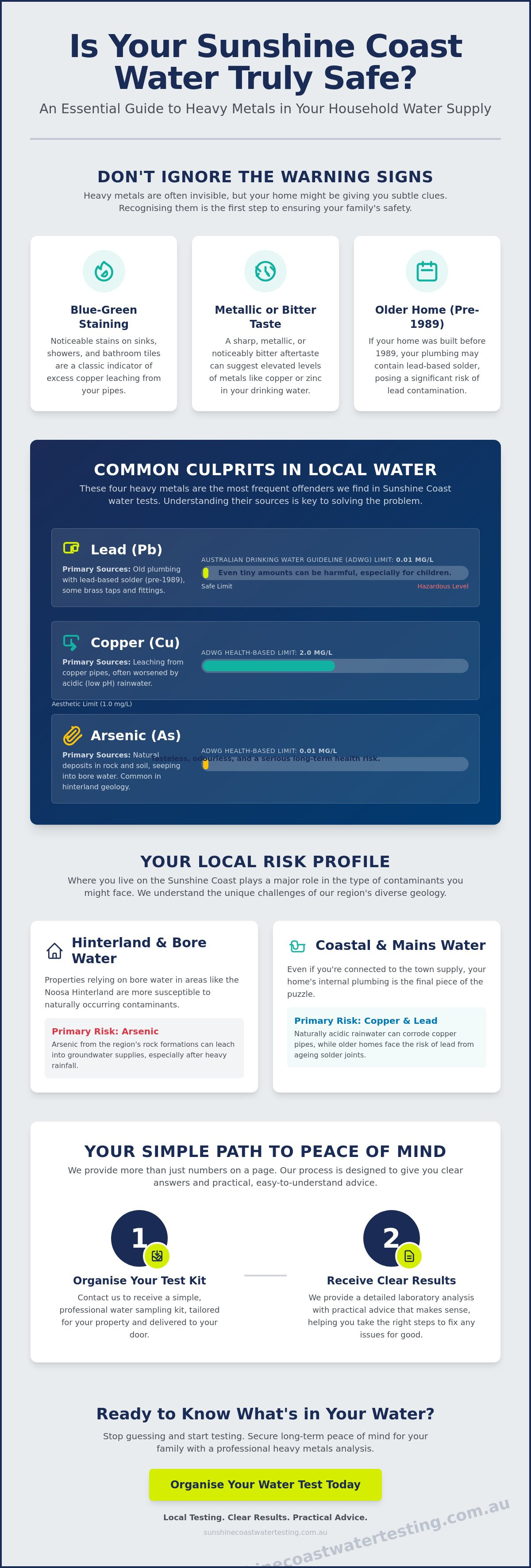
Don't trust your eyes when it comes to water safety. Heavy metals are almost always tasteless, odourless, and invisible to the naked eye. You won't see a metallic sheen or smell a chemical tang even if your lead levels are over the recommended 0.01 mg/L limit. There's a dangerous myth that boiling water removes these contaminants. In reality, boiling causes water to evaporate, which actually concentrates the heavy metals left in the pot. Potability refers to water that contains heavy metal concentrations strictly below the thresholds set by the ADWG, making it safe for long-term human consumption.
Local Risks: From Noosa Hinterland Bores to Coastal Mains
Geography dictates your specific risk profile. In Noosa Hinterland pockets, we frequently identify arsenic in bore water samples, which is a result of the region's specific rock formations and historical land use. Coastal residents face a different challenge. The Sunshine Coast's naturally acidic rainwater can aggressively leach copper from household plumbing, often evidenced by blue-green staining on bathroom tiles. If you're in an established area like Noosaville or Nambour, older infrastructure and lead-based solder in 30-year-old pipes remain a primary concern. Professional heavy metals testing provides "More Than Just Numbers on a Page" by identifying these site-specific risks and telling you exactly what to do next.
Common Toxic Metals Found in Local Bore and Tank Water
Is your tap water as safe as it looks? While Sunshine Coast water usually appears crystal clear, invisible contaminants often hide beneath the surface. Professional heavy metals testing identifies specific elements that can't be seen, smelled, or tasted. Identifying these risks early is the first step toward securing a healthy household supply.
- Lead: This often enters the supply through old lead-based solder in pre-1989 plumbing or through certain brass fittings and taps. Even low levels are a concern for developing children and long-term health.
- Copper: Have you noticed blue-green staining on your white porcelain or a sharp, bitter taste? This usually indicates copper leaching from pipes, often triggered by corrosive, low-pH water.
- Arsenic: A naturally occurring element in various Queensland groundwater systems. It can seep into bores from surrounding rock and soil, particularly in areas with specific geological formations.
- Cadmium and Nickel: These are less common but critical to monitor if you live near industrial zones or high-traffic areas where metallic runoff is more frequent.
The Problem with Bore Water and Groundwater
Sunshine Coast aquifers aren't static environments. Mineral levels fluctuate significantly following heavy rainfall events, such as the 500mm deluges often seen during the summer months. These weather patterns can flush historic agricultural residues into your private supply. For example, some old orchards and farms used arsenic-based pesticides decades ago that still linger in the soil. To keep your family safe, refer to the Australian Drinking Water Guidelines for established safety thresholds. You should organise an urgent check if you notice:
- A sudden change in water clarity or colour after a storm.
- Unusual saltiness or a metallic "tang" on the palate.
- Struggling garden plants or unexplained "burnt" leaf edges after irrigation.
Rainwater Tanks: More Than Just Debris
Don't assume tank water is pure just because it fell from the sky. Rainwater is naturally slightly acidic. When this water sits in your tank, it can react with metal tank linings, roof flashings, and lead-headed nails used on older Queenslander roofs. Over time, heavy metals settle into the sediment at the bottom of the tank. If your pump intake draws from this lower layer, you might be pulling concentrated contaminants directly into your kitchen. A visual inspection for leaves and mosquitoes is a good start, but it won't reveal chemical risks. Getting a regular water analysis is the only way to ensure your tank isn't concentrating harmful elements. Comprehensive heavy metals testing provides the data you need to choose the right filtration system and gain total peace of mind.
Testing Your Water vs. Testing Your Health: Why Prevention Matters
Why wait for a medical diagnosis to find out your family has been exposed to lead or copper? A blood test is a reactive measure. It confirms that heavy metals have already entered your bloodstream and begun accumulating in your organs. For Sunshine Coast residents, heavy metals testing at the tap represents a shift from reactive medicine to primary prevention. By identifying contaminants at the source, you stop the exposure before the first sip is even taken.
Choosing a laboratory water analysis is significantly more cost-effective than long-term medical monitoring or chelation therapies. While a doctor's report provides a diagnosis, a water report provides a roadmap. It tells you exactly which contaminants are present, allowing you to choose a filtration system that actually works for your specific water chemistry. We benchmark every result against the Australian Drinking Water Guidelines, ensuring you have a clear scientific standard to measure your home's safety against.
Source Testing: Stopping Exposure at the Tap
We use a two-step sampling process to pinpoint exactly where metals are entering your water. The "First Flush" sample captures water that has sat in your pipes overnight, which identifies if your household plumbing or brass fittings are leaching metals. The "Flushed" sample is taken after the tap has run for two minutes, revealing the quality of the water entering your property from the mains or tank. This distinction is vital. It ensures you don't spend thousands on a whole-house filtration system if the problem is simply a single corroded kitchen tap. Water analysis is the only scientific way to verify that your current filter is performing to its advertised standard.
Peace of Mind for Acreage and Regional Properties
Parents and pet owners on independent water supplies often carry a silent anxiety about what's in their tank or bore. Unlike town water, which is monitored by the council, the responsibility for safety on acreage properties falls entirely on the owner. We provide the reassurance of a NATA accredited laboratory report that delivers "More Than Just Numbers on a Page." You receive a professional breakdown of your water quality without the stress of a sales pitch. Our "No Spam" policy means we provide your results and practical advice, then leave the next steps to you. There are no high-pressure tactics or follow-up calls trying to sell you proprietary hardware. You get honest data from a local expert who values your family's health as much as you do.
How to Organise a Heavy Metal Water Analysis for Your Property
Getting your water checked shouldn't feel like a chemistry exam. We've streamlined the process for Sunshine Coast residents so you can get answers without the stress. Our system follows a logical path from your first enquiry to a final resolution. Follow these five simple steps to secure your peace of mind.
- Step 1: Contact Sunshine Coast Water Testing to select your specific test package. We'll help you decide if you need a broad screen or a targeted analysis based on your water source.
- Step 2: Receive your professional sampling kit. It arrives with clear, easy instructions that take the guesswork out of the process.
- Step 3: Collect your water samples from the relevant taps or bore heads. The process is quick and usually takes less than ten minutes to complete.
- Step 4: Return the samples to our local collection centre. We ensure they're handled correctly for professional laboratory analysis.
- Step 5: Receive your "More Than Just Numbers" report. You'll get a digital copy filled with practical advice tailored to your specific results.
Choosing the Right Test Package
Are you testing a standard town water connection or a private bore? A Standard Drinking Water Test covers the basics, but a targeted heavy metals testing suite is essential if you suspect old copper pipes or industrial runoff. If you're using tank water, we recommend adding a Microbiological Analysis to check for E. coli. For those buying a new property in Noosa or Maroochydore, performing this due diligence during the 14-day building and pest period is a smart move. It ensures you don't inherit a costly filtration problem or a contaminated bore.
What to Expect in Your Results
We're committed to providing "Reports That Actually Make Sense" for non-scientists. You won't just get a spreadsheet of parts per billion that requires a degree to decode. We compare every finding against the Australian Drinking Water Guidelines (ADWG) 2011 standards. This gives you a clear benchmark for safety. Our focus remains on "Practical Advice Only." If a level is high, we tell you exactly what to do next. Whether it's installing a specific carbon filter or servicing your bore, you'll have a clear path forward. We believe local families deserve clarity, not confusion. Local Testing. Clear Results. Practical Advice.
Ready to ensure your tap water is safe for your family? Order your heavy metals testing kit today for fast, local results.
Local Testing. Clear Results. Practical Advice for Coast Families
Choosing the right partner for your water safety shouldn't be a guessing game. While cheap DIY kits from a local hardware store might offer a quick result, they often lack the precision needed to detect low levels of lead, copper, or arsenic. Professional heavy metals testing through a certified laboratory ensures your results are legally defensible and scientifically accurate. We provide Sunshine Coast families with the clarity they need without the confusing jargon. Because we're based right here in Noosaville, your samples don't sit in a hot courier van for days. They get processed quickly, giving you answers when you need them most.
The Sunshine Coast Water Testing Difference
Our business model is built on a simple principle: we provide data, not sales pitches. Unlike many water companies, we don't sell plumbing services, filtration systems, or expensive replacement cartridges. This independence means our reports are completely unbiased. You get the facts about your water quality without the pressure to buy an A$5,000 filtration unit you might not even need. We believe in providing more than just numbers on a page. Our goal is to offer practical advice that actually makes sense for your household. We maintain a strict "no spam" policy and never pass your details to third-party contractors.
For those relying on collected water, our Rainwater Tank Health Check provides a comprehensive overview of your system's safety. This service ensures your family's primary water source remains a health asset rather than a hidden risk. Our difference includes:
- Independent Data: Third-party scientific results with no hidden agenda.
- Local Expertise: Knowledge of specific Sunshine Coast conditions, from coastal salt spray to Hinterland bore issues.
- Clear Communication: Reports designed for homeowners, not just scientists.
Get Started Today
Protecting your home shouldn't be a complicated process. We've streamlined our heavy metals testing to be as fast and easy as possible for busy property owners. Our team covers the entire region, from the coastal hubs of Noosa and Maroochydore to the rural properties across the Hinterland. Whether you're on town water, a bore, or a tank, we have the local expertise to identify specific regional risks. Don't leave your family's health to chance or a simple strip of reactive paper. Secure your peace of mind with a professional analysis that delivers clear, actionable results.
Take the first step toward a safer home today: Book Your Heavy Metals Water Test Today
Protect Your Home With Clear Answers
You shouldn't have to guess what's in your glass. Whether you're relying on a local bore or a rainwater tank, heavy metals like lead or arsenic can accumulate without changing the taste or smell of your water. Relying on health symptoms to alert you to a problem is a risk you don't need to take. Our local Sunshine Coast specialists provide a clear path forward through professional heavy metals testing. We use NATA accredited laboratory analysis to ensure every result is accurate and meets strict Australian standards. You won't receive a confusing spreadsheet full of scientific jargon; instead, we provide reports that actually make sense. It's about getting practical advice so you can make informed decisions for your property immediately. Peace of mind comes from knowing exactly what's flowing through your taps every day. Testing isn't just about data; it's about ensuring the long-term health of your household and the integrity of your water supply. Take the guesswork out of your household safety and trust the experts who live and work right here on the Coast. Your family deserves water that's both clean and verified.
Ensure your water is safe-book a Heavy Metals Test with Sunshine Coast experts today.
Frequently Asked Questions
Is heavy metals testing necessary if I am on Sunshine Coast town water?
Yes, testing is still important because your home's internal plumbing is often the primary source of contamination. While the local water authority ensures the municipal supply meets the Australian Drinking Water Guidelines, older homes in areas like Nambour or Caloundra built before 1989 may have lead solder or brass fittings. Professional heavy metals testing identifies if these materials are leaching toxins into your glass after the water leaves the main council pipes.
How often should I test my bore water for heavy metals?
You should test your bore water at least once every 12 months to account for seasonal changes and environmental shifts. Groundwater quality in Noosaville and the surrounding hinterland can fluctuate based on rainfall patterns and local land use. Annual checks ensure your current filtration setup is still managing specific elements like arsenic or manganese effectively for your household's safety.
Can I use a DIY kit for heavy metals testing at home?
No, DIY kits usually lack the sensitivity required to detect dangerous levels defined by national health standards. Most off the shelf kits only react to concentrations above 100 parts per billion, yet the Australian Drinking Water Guideline limit for lead is a much stricter 0.01 milligrams per litre. We provide laboratory analysis that gives you precise data rather than a vague colour change on a strip.
What are the symptoms of heavy metals in drinking water?
You cannot always taste or smell heavy metals, but physical indicators like blue-green staining on white porcelain sinks often signal high copper levels. When copper exceeds 1 milligram per litre, it leaves visible marks on baths and basins. Because lead and cadmium are tasteless and odourless, professional heavy metals testing is the only certain way to know your water is clear of these invisible risks.
Does a standard carbon filter remove all heavy metals?
A standard activated carbon filter is generally insufficient for removing most dissolved heavy metals on its own. While these filters are excellent for removing chlorine and improving taste, you typically need specialised media like Ion Exchange or Reverse Osmosis to target lead and mercury. Always check if your system carries an NSF/ANSI 53 certification, which confirms it's rated to reduce specific metallic contaminants.
What happens if my water test shows high levels of lead or copper?
If your results exceed the Australian Drinking Water Guidelines, you should stop using the water for drinking or cooking immediately and locate the source. We provide a report that is more than just numbers on a page, offering practical advice on your next steps. This might involve replacing a specific brass tap or installing a point of entry filtration system to bring levels back to a safe range.
How long does it take to get my water testing results back?
You will receive your clear, easy to understand report within 5 to 7 business days after our laboratory receives your sample. We focus on a fast and efficient turnaround because we know Sunshine Coast families want peace of mind quickly. Our process is designed to be simple, providing you with results that actually make sense so you can make informed decisions about your home's water quality.

Article by
Stephen McDougall
Stephen McDougall is the owner of Pristine Water Systems Sunshine Coast and Sunshine Coast Water Testing, specialising in water quality, filtration, and tank systems. He is known for delivering clear, easy-to-understand advice and practical solutions to help clients maintain safe, reliable water.
Disclaimer
The information provided in this article is for general guidance only and is not a substitute for professional water testing or site-specific advice. Water quality can vary between properties. For accurate results and recommendations, we recommend professional testing and assessment.