
Why water testing matters in Mooloolaba
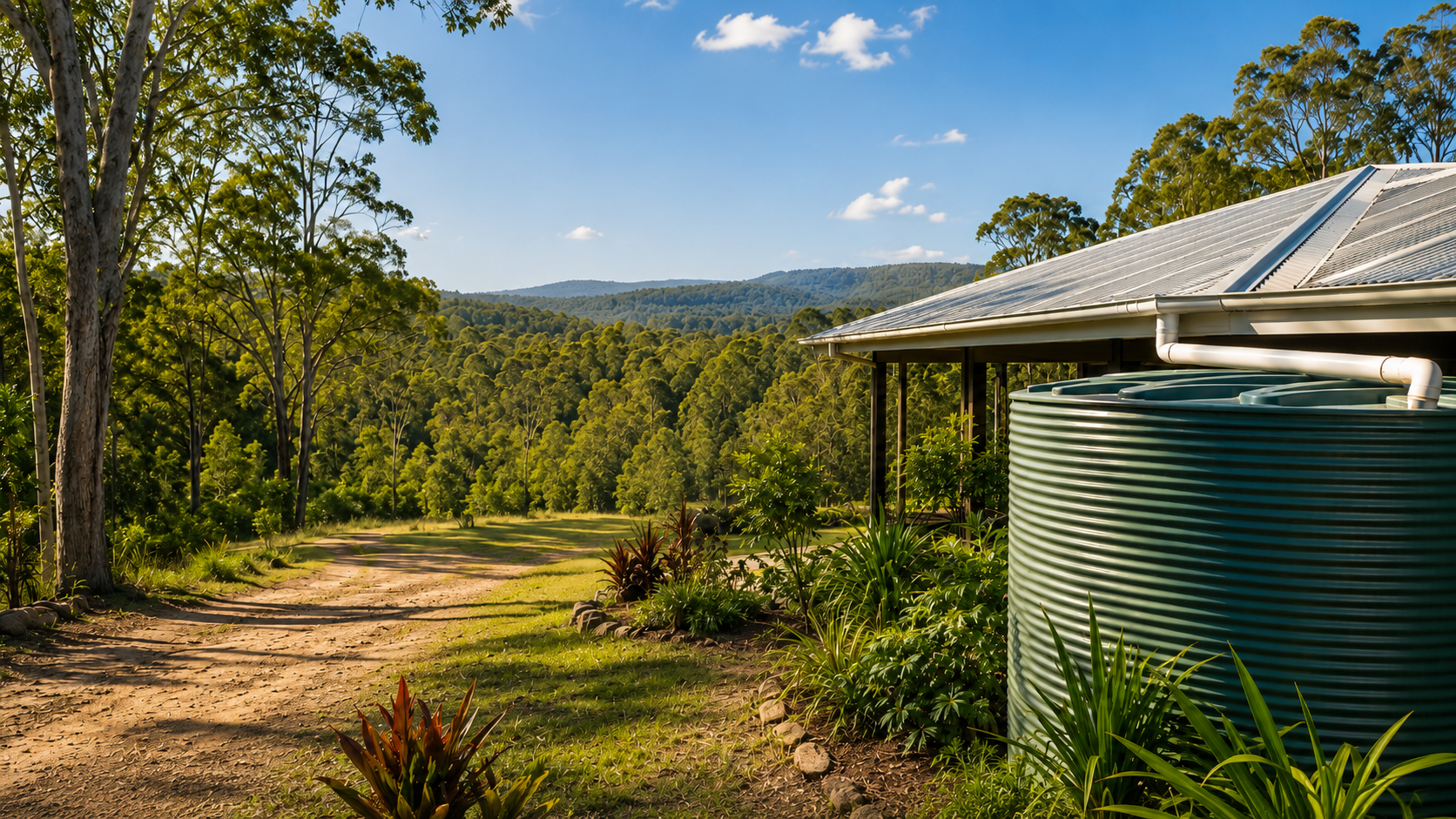
Mooloolaba is largely on town water, so most of our Mooloolaba customers come to us about a specific part of their supply — a rainwater tank plumbed to the garden, the laundry, the pool top-up, or the outdoor beach-rinse shower; an older mixed system where the tank still feeds an internal outlet; or a long-held block with a shallow bore that hasn't been touched in years. We focus only on those self-supplied parts of your property. The coastal setting puts a particular set of pressures on tank catchments — salt aerosol, sand, sub-tropical algal growth, and rapid refreshes during east-coast lows — and our reports translate the lab results into plain language for tank-only or mixed-system Mooloolaba homes.
Local context: Mooloolaba tanks sit in salt-laden coastal air which corrodes inlet screens and first-flush hardware faster than inland sites. Properties closest to the esplanade and surf club routinely catch wind-blown salt aerosol on the roof, and dark tanks in full coastal sun can develop algal blooms in summer.
Likely water sources in Mooloolaba
- Rainwater tanks on detached Mooloolaba homes feeding garden, laundry or outdoor showers
- Tank-fed pool top-up and beach-rinse outdoor showers on coastal blocks
- Mixed tank + town-water systems on older canal-front and back-block houses
- Occasional shallow bores on long-held larger blocks set back from the foreshore
Common local water concerns
- Salt-laden coastal air corroding tank inlet screens and shortening first-flush diverter life in beachfront Mooloolaba locations
- Wind-blown sand and salt aerosol depositing on roof catchments closest to the surf club and esplanade
- Sub-tropical algal growth in dark plastic tanks left in full coastal sun without inlet shading
- Pool-top-up tank lines developing chlorine cross-contamination on properties where the same tank is used for both
- Rapid catchment refresh during cyclonic / east-coast-low events stirring up sediment that hadn't been disturbed for months
Recommended test packages for Mooloolaba
Based on the typical water-supply profile and property mix in this suburb. You can also mix and match samples — e.g. one tap and one tank — on a single booking.
Sample collection & drop-off
- Use a sterile sample bottle (we supply one when you book).
- Keep your sample cool and out of direct sunlight after collection.
- Bacterial samples must reach the lab within 24 hours of collection.
- Drop-off: 1/37 Gateway Drive, Noosaville QLD 4566 — Monday to Thursday before 2 pm.
Mooloolaba is approximately 35 minutes by car from our Noosaville lab at 1/37 Gateway Drive. Drop-off accepted before 2 pm Monday to Thursday — bacterial samples must reach us within 24 hours of collection for accurate E. coli and coliform analysis.
Local FAQ — Mooloolaba
Most of our Mooloolaba home runs on town water — do we need a tank test at all?
If your tank is purely decorative and never plumbed in, no. If it feeds anything — laundry, garden tap, outdoor shower, pool top-up — yes, because that water still ends up on skin, on clothes, on edible garden produce and in your pool. We size the test to how the tank is actually used.
Our Mooloolaba tank only fills the pool — should we test it?
Yes, especially if a household member uses the pool. A Basic Water Safety Check is usually the right starting point — it confirms whether the tank water you're adding to the pool is microbiologically clean and at the right pH range, so it doesn't undermine your sanitiser balance.
I'm a Mooloolaba landlord — should I test my rental's tank for the tenancy?
We can absolutely test the rainwater tank that serves the property. Just note that we're an independent water testing lab, not a tenancy-compliance certification service — we provide a plain-English Certificate of Analysis you can share with your tenant, agent, or plumber. We don't issue tenancy-law sign-offs.
After the last big east-coast low, our Mooloolaba tank water tasted different. What should I book?
A storm of that scale typically stirs up months of accumulated sediment in the tank and flushes new debris off the roof. Start with an Essential Tank Water Test — it covers both the microbiological side and the physical-chemical side (turbidity, conductivity, pH) so you can see if the storm shifted things.
How long do water testing results take?
Most reports are usually returned within 1–3 days, depending on the test package, sample timing and lab workload. Bacterial tests (E. coli, coliforms) start the day your sample arrives at the lab.
What's the difference between a Basic test and an Essential test?
Basic Water Safety Check ($79 prepaid, was $99) screens for E. coli (Positive/Negative) and Total Coliforms (Positive/Negative) plus pH and Conductivity — answering the question 'is my water safe to drink?'. The Essential Tank Water Test ($143 prepaid, was $179) adds TDS, turbidity, alkalinity, hardness, cations, anions and metals — giving you a broader picture of your rainwater tank's water quality and overall system health.