
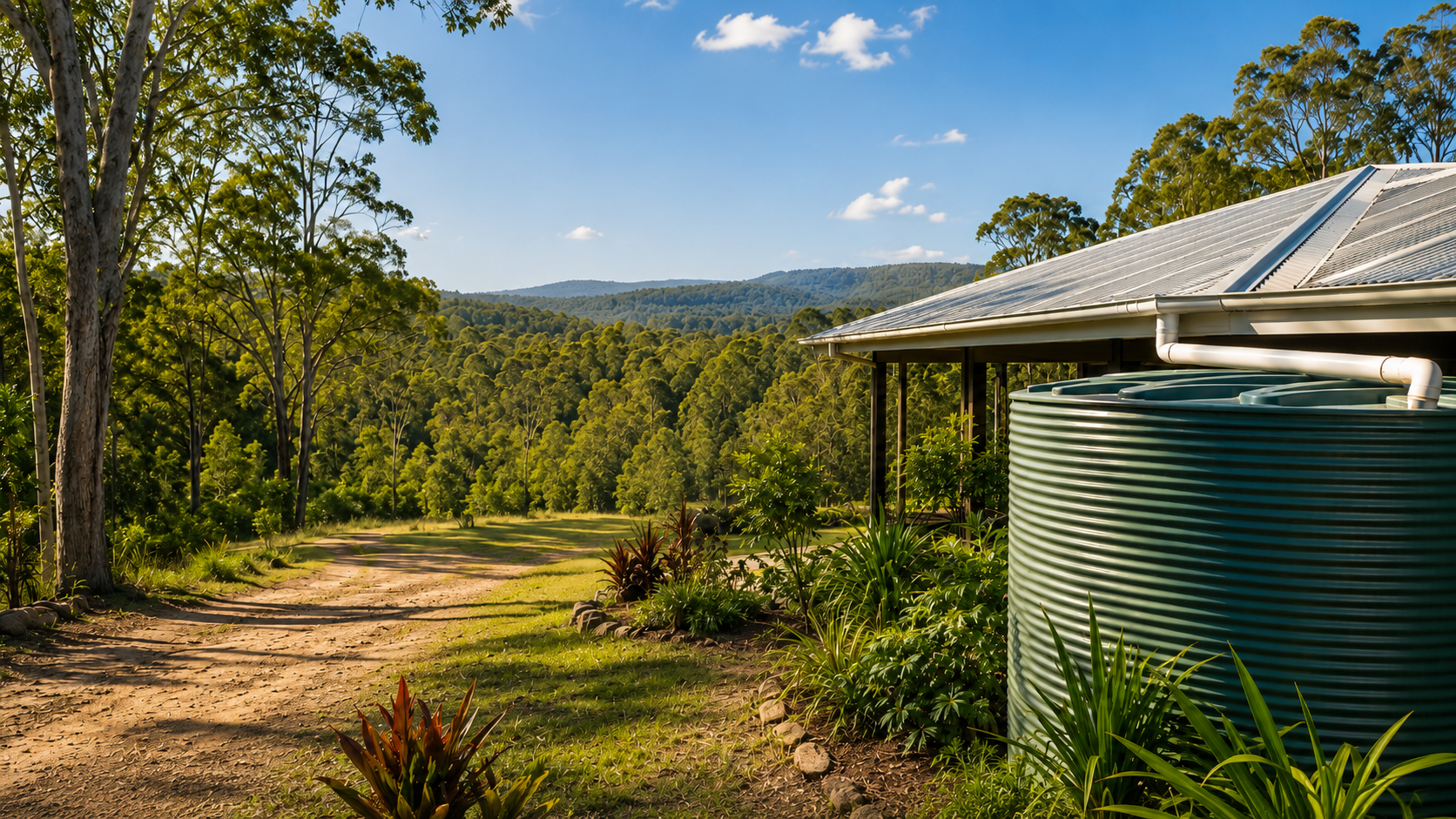
Why water testing matters in Sippy Downs
Sippy Downs is mostly modern estate housing on town water, but under the newer stormwater code most homes here have a rainwater tank built in — typically plumbed for laundry, toilet flushing, garden irrigation, or pool top-up. We focus on those self-supplied parts of the property. Tanks at Sippy Downs are usually slimline poly units installed against the side of the house with limited inspection access, and the tank water often runs through internal plumbing via a pressure pump and pre-filter that owners rarely think about. That setup has its own set of localised risk patterns worth measuring.
Local context: Sippy Downs estate tanks are typically tucked into narrow eave gaps with little inspection access, which lets biofilm and sediment build up unnoticed. Pressure-pump systems also pull tank water deep into the home's plumbing, so any tank-side issue can show up at internal outlets the owner didn't realise were tank-fed.
Likely water sources in Sippy Downs
- Rainwater tanks plumbed for laundry, garden or outdoor entertaining on most Sippy Downs homes (modern stormwater code)
- Tank top-up to swimming pools on newer Sippy Downs estate builds
- Mixed tank + town-water systems where the tank feeds toilets or laundry under newer-build plumbing
- Tank-fed irrigation for landscaped front gardens common across the area's estate housing
Common local water concerns
- Estate-build poly tanks installed under eaves with limited inspection access leading to undetected biofilm growth in Sippy Downs
- Newer pressure-pump systems running tank water through internal plumbing with rare cleaning of the pump pre-filter
- Tank top-up float valves seizing on long-held Sippy Downs estate homes after extended dry periods
- Tank-to-toilet line stagnation on Sippy Downs builds where the toilets are rarely flushed (holiday absences, second bedrooms)
- Pool top-up tank lines developing chlorine cross-contamination on Sippy Downs builds with shared tank/pool top-up plumbing
Recommended test packages for Sippy Downs
Based on the typical water-supply profile and property mix in this suburb. You can also mix and match samples — e.g. one tap and one tank — on a single booking.
Sample collection & drop-off
- Use a sterile sample bottle (we supply one when you book).
- Keep your sample cool and out of direct sunlight after collection.
- Bacterial samples must reach the lab within 24 hours of collection.
- Drop-off: 1/37 Gateway Drive, Noosaville QLD 4566 — Monday to Thursday before 2 pm.
Sippy Downs is approximately 40 minutes by car from our Noosaville lab at 1/37 Gateway Drive. Drop-off accepted before 2 pm Monday to Thursday — bacterial samples must reach us within 24 hours of collection for accurate E. coli and coliform analysis.
Local FAQ — Sippy Downs
We bought our Sippy Downs estate home a few years ago and have never opened the tank. Should we be worried?
Not worried, but informed. Slimline estate tanks installed under eaves often go years without an inspection because access is awkward. An Essential Tank Water Test tells you whether the inside is performing the way it should — and if results are clean you've got reassurance. If anything's elevated, the plain-English report explains practical next steps such as a tank clean or first-flush check.
Our Sippy Downs home has tank-to-toilet plumbing — does that need testing too?
Yes, especially if some of the toilets are rarely used (guest bathroom, second-bedroom ensuite, etc.). Stagnant tank-fed toilet lines can build biofilm that an Essential Tank Water Test will pick up on the microbiological side. Annual testing is a sensible cadence for estate homes with extensive tank-fed internal plumbing.
We use our Sippy Downs tank to top up the pool. Is that worth testing separately?
If the tank top-up shares plumbing with the pool, yes — a Basic Water Safety Check on the tank tells you whether the rainwater being added is microbiologically clean and at the right pH range, so it doesn't undermine your sanitiser balance. If the same tank also feeds laundry or toilets, step up to the Essential Tank Water Test.
How long do water testing results take?
Most reports are usually returned within 1–3 days, depending on the test package, sample timing and lab workload. Bacterial tests (E. coli, coliforms) start the day your sample arrives at the lab.
What's the difference between a Basic test and an Essential test?
Basic Water Safety Check ($79 prepaid, was $99) screens for E. coli (Positive/Negative) and Total Coliforms (Positive/Negative) plus pH and Conductivity — answering the question 'is my water safe to drink?'. The Essential Tank Water Test ($143 prepaid, was $179) adds TDS, turbidity, alkalinity, hardness, cations, anions and metals — giving you a broader picture of your rainwater tank's water quality and overall system health.