
Why water testing matters in Nambour
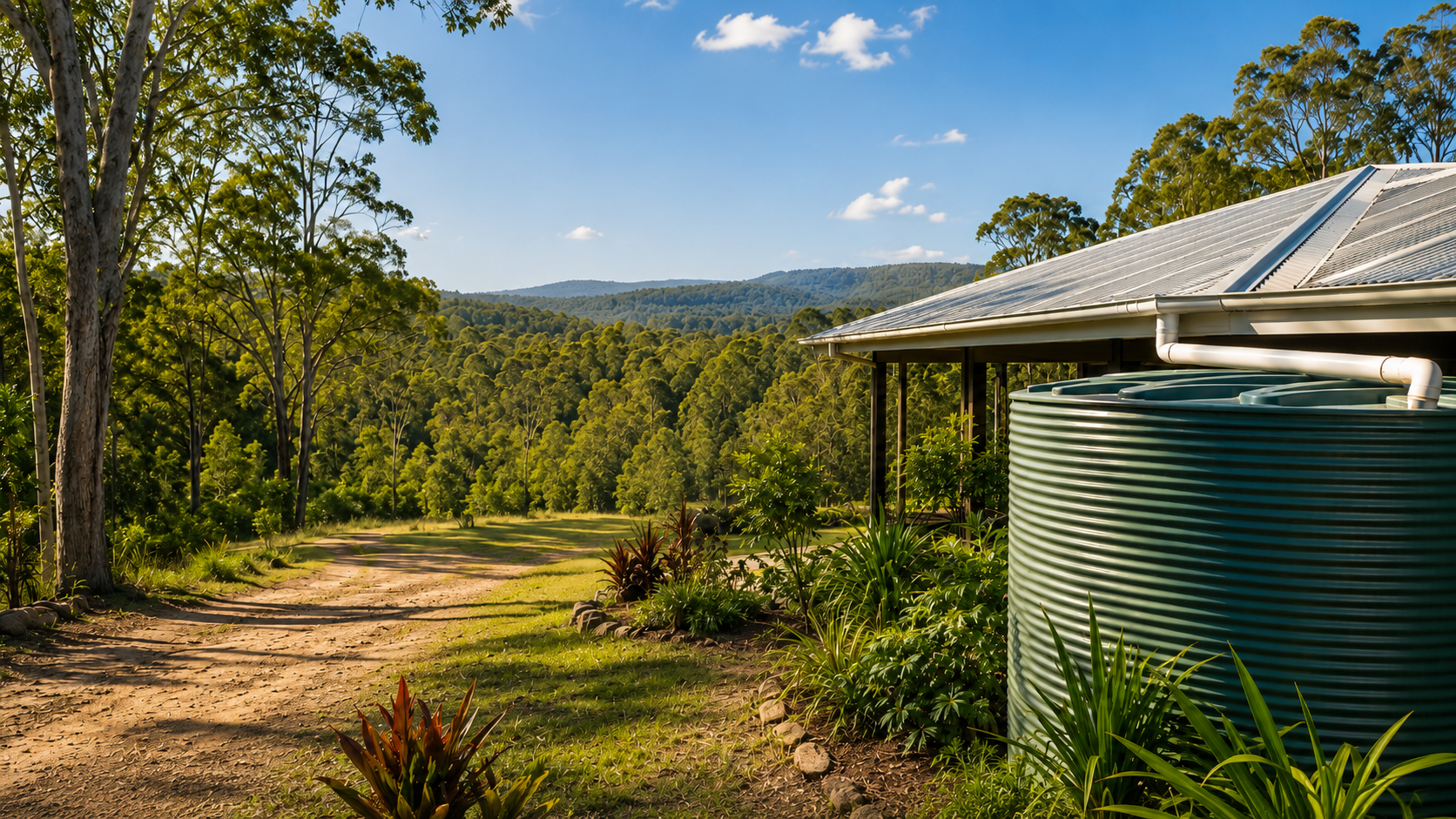
Nambour sits where the Sunshine Coast hinterland meets the regional town centre, and that mix shows in the way people get their water. Many Nambour homes are heritage Queenslanders that have kept their original rainwater tank for the laundry, the garden, or a tank-fed outdoor tap — even when the rest of the property runs on town water. Out on the Image Flat, Coes Creek, Dulong, Kureelpa and Perwillowen fringes, full rainwater-tank and private-bore households are still very common. We focus only on the parts of your supply that come from your own tank or bore — independent testing with plain-English reports so you understand what's actually in the water at the outlet you use for drinking, cooking, washing or stock.
Local context: Nambour's older homes often retain concrete or galvanised tanks that can lift pH or shed zinc, while hinterland-fringe properties catch leaf litter, bats and possums off the Blackall Range. Bores on the Image Flat and Coes Creek alluvial flats often show iron, manganese and hardness variability.
Likely water sources in Nambour
- Rainwater tanks plumbed for drinking, laundry or garden on older Nambour homes
- Tank-fed outdoor taps and outdoor kitchens on hinterland-side blocks
- Private bores on Image Flat, Dulong, Coes Creek and Kureelpa acreage fringes
- Mixed tank + town-water systems on heritage Queenslanders that retained their original tanks
Common local water concerns
- Old concrete tanks retained on heritage Nambour Queenslanders developing rendering / lime leaching that lifts pH
- Rural-fringe roof catchments collecting bat and possum droppings off the Blackall Range escarpment
- Bore-side iron staining on Image Flat and Coes Creek small-farm aquifers
- Aged galvanised gutter and downpipe runs adding zinc to tank water on long-held Nambour properties
- Hinterland-canopy leaf litter blocking first-flush diverters on Dulong and Perwillowen fringes after summer storms
Recommended test packages for Nambour
Based on the typical water-supply profile and property mix in this suburb. You can also mix and match samples — e.g. one tap and one tank — on a single booking.
Essential Tank Water Test
Adds TDS, turbidity, alkalinity, hardness and metals — full rainwater-tank picture.
Basic Water Safety Check
E. coli, total coliforms, pH, conductivity — the core safe-to-drink screen.
Sample collection & drop-off
- Use a sterile sample bottle (we supply one when you book).
- Keep your sample cool and out of direct sunlight after collection.
- Bacterial samples must reach the lab within 24 hours of collection.
- Drop-off: 1/37 Gateway Drive, Noosaville QLD 4566 — Monday to Thursday before 2 pm.
Nambour is approximately 25 minutes by car from our Noosaville lab at 1/37 Gateway Drive. Drop-off accepted before 2 pm Monday to Thursday — bacterial samples must reach us within 24 hours of collection for accurate E. coli and coliform analysis.
Local FAQ — Nambour
Our Nambour Queenslander still has its original concrete tank — should we test even if it only feeds the laundry?
Yes — even when a heritage tank is only plumbed to a laundry or outdoor tap, the water still ends up on skin, on clothes washed by hand, on garden produce, and in pet bowls. An Essential Tank Water Test covers the bacteriology and the chemistry that matter for older concrete tanks, including pH (which often climbs on lime-leaching renders) and hardness.
Most of our Nambour property runs off town water, but our garden tap is tank-fed. What test should I book?
If only a single outdoor or laundry tap is fed by the tank, the Basic Water Safety Check is usually the sensible starting point — it screens for E. coli, total coliforms, pH and conductivity. If anyone drinks from that tap, washes vegetables under it, or fills a pet bowl, step up to the Essential Tank Water Test for the wider profile.
We're on a small farm at Image Flat with a tank in the house and a bore for the paddocks. What do you recommend?
For Image Flat properties we usually suggest pairing the Essential Tank Water Test (drinking-water side) with the Essential Bore Water Test (stock and irrigation side) — they cover very different parameter sets. Run both in the same drop-off so you have a clear picture of both systems on the same week.
Does SCWT test town-water taps in Nambour?
No — we focus on rainwater tanks and bores. Town water (Unitywater) is already monitored by your utility for compliance, so it isn't part of our testing scope. We test the parts of your supply that come from your own roof catchment or your own bore.
How long do water testing results take?
Most reports are usually returned within 1–3 days, depending on the test package, sample timing and lab workload. Bacterial tests (E. coli, coliforms) start the day your sample arrives at the lab.
What's the difference between a Basic test and an Essential test?
Basic Water Safety Check ($79 prepaid, was $99) screens for E. coli (Positive/Negative) and Total Coliforms (Positive/Negative) plus pH and Conductivity — answering the question 'is my water safe to drink?'. The Essential Tank Water Test ($143 prepaid, was $179) adds TDS, turbidity, alkalinity, hardness, cations, anions and metals — giving you a broader picture of your rainwater tank's water quality and overall system health.