
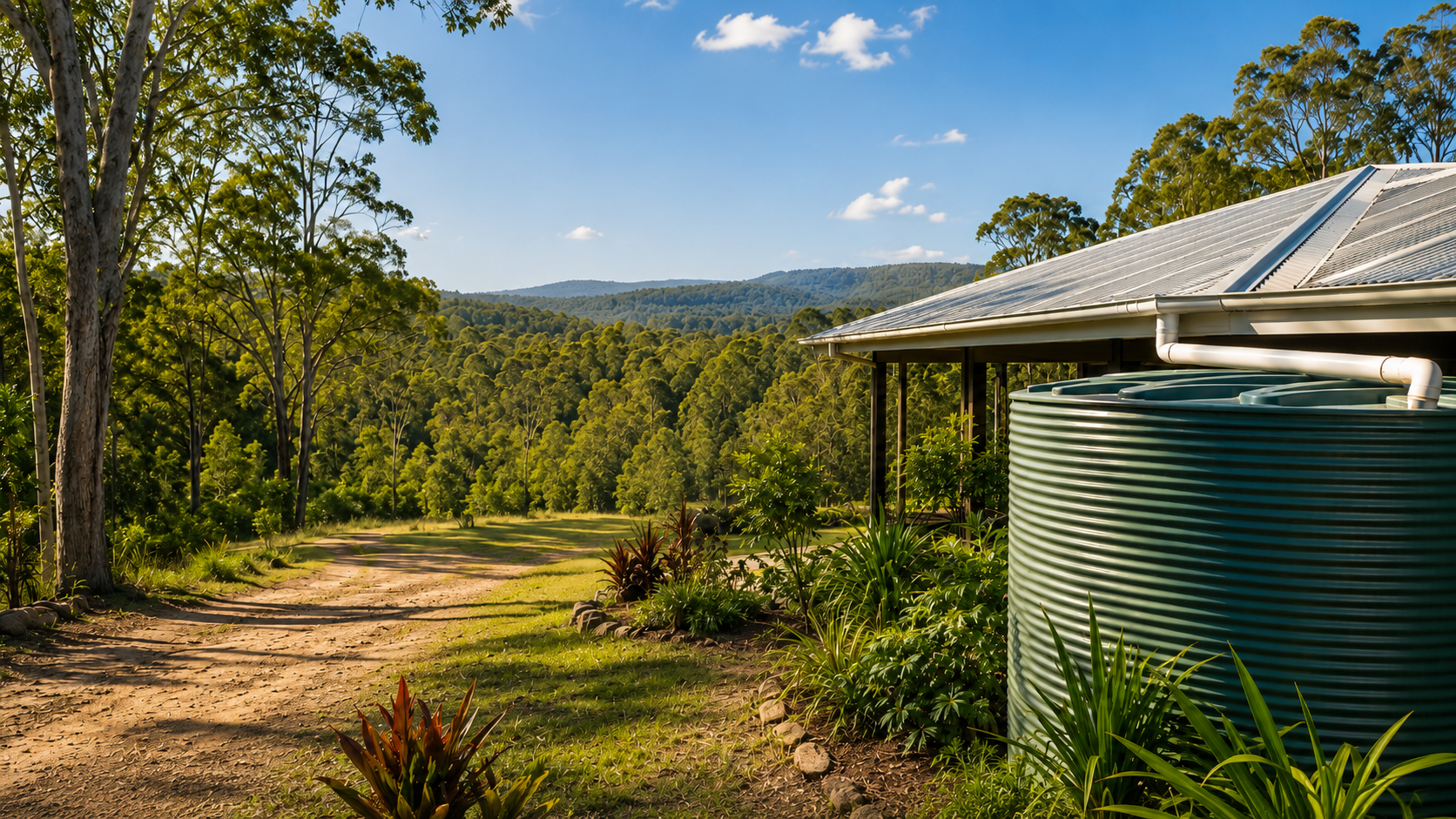
Why water testing matters in Palmwoods
Palmwoods is fruit-growing hinterland country — avocado, macadamia, citrus and pineapple blocks blend with bushland acreage and a tight village core, and tank water plus bore water are the everyday norm outside the village itself. Most Palmwoods, Chevallum, Hunchy and Ilkley households run partly or entirely on what their own roof catches, and many also have a bore for orchard irrigation, stock and household top-up. The combination of sub-tropical canopy, orchard activity and a sandstone-influenced aquifer creates a fairly specific risk profile that is worth measuring directly, especially after wet seasons or roof cleans.
Local context: Palmwoods catchments often sit under productive fruit-tree canopies that attract fruit-fly traffic and birds, raising organic-matter loads in tanks. Bores across the area are commonly iron- and manganese-influenced from the sandstone-derived aquifer, and orchard spray drift is a localised consideration for open catchments.
Likely water sources in Palmwoods
- Full rainwater-tank households on Chevallum, Hunchy and Ilkley acreage
- Tank + private bore combinations on long-held Palmwoods orchard and small-farm blocks
- Mixed tank + town-water on village-side Palmwoods homes that retained original tanks
- Dam and creek water used for irrigation, livestock and orchard spraying
Common local water concerns
- Heavy fruit-fly and possum activity off Chevallum and Hunchy orchard canopies dropping organic matter onto tank inlets
- Sub-tropical wet-season biofilm developing in poly tanks shaded by mature avocado and macadamia plantings
- Iron- and manganese-rich shallow bores common across the Palmwoods sandstone-influenced aquifer
- Spray-drift residues from neighbouring orchard operations potentially entering open tank catchments
- Old galvanised header tanks remaining on heritage Palmwoods village properties with copper-plumbed downstream lines
Recommended test packages for Palmwoods
Based on the typical water-supply profile and property mix in this suburb. You can also mix and match samples — e.g. one tap and one tank — on a single booking.
Essential Tank Water Test
Adds TDS, turbidity, alkalinity, hardness and metals — full rainwater-tank picture.
Essential Bore Water Test
Iron, manganese, hardness, conductivity, pH — tailored to bore chemistry.
Sample collection & drop-off
- Use a sterile sample bottle (we supply one when you book).
- Keep your sample cool and out of direct sunlight after collection.
- Bacterial samples must reach the lab within 24 hours of collection.
- Drop-off: 1/37 Gateway Drive, Noosaville QLD 4566 — Monday to Thursday before 2 pm.
Palmwoods is approximately 40 minutes by car from our Noosaville lab at 1/37 Gateway Drive. Drop-off accepted before 2 pm Monday to Thursday — bacterial samples must reach us within 24 hours of collection for accurate E. coli and coliform analysis.
Local FAQ — Palmwoods
We grow avocados at Palmwoods and the tank sits under the canopy edge — is that a problem?
It's worth being aware of. Productive orchard canopies attract birds, fruit-fly traffic and possums, and the organic matter they drop onto the roof catchment can lift E. coli and total coliform counts after rain. The Essential Tank Water Test gives you a microbiological picture as well as the chemistry — and if results come back elevated, your plain-English report explains practical next steps.
Our Hunchy bore has bad iron staining on the laundry tub. What do you suggest?
Iron-rich bores are common across the Palmwoods hinterland because of the sandstone-influenced aquifer. The Essential Bore Water Test measures iron, manganese, hardness, conductivity and pH, so the report tells you whether the staining is what we'd expect from your specific bore and helps you decide whether filtration or treatment is worth the investment.
We're a Palmwoods small farm with the tank for the house and a bore for orchard irrigation — should we test the bore even though we don't drink it?
Yes. A bore that irrigates edible orchard fruit still influences what ends up in the harvest, and bore chemistry can also affect pump life and irrigation hardware. A one-off Essential Bore Water Test gives you a baseline you can compare against in future seasons.
How long do water testing results take?
Most reports are usually returned within 1–3 days, depending on the test package, sample timing and lab workload. Bacterial tests (E. coli, coliforms) start the day your sample arrives at the lab.
What's the difference between a Basic test and an Essential test?
Basic Water Safety Check ($79 prepaid, was $99) screens for E. coli (Positive/Negative) and Total Coliforms (Positive/Negative) plus pH and Conductivity — answering the question 'is my water safe to drink?'. The Essential Tank Water Test ($143 prepaid, was $179) adds TDS, turbidity, alkalinity, hardness, cations, anions and metals — giving you a broader picture of your rainwater tank's water quality and overall system health.