How to Use a Drinking Water Test Kit: DIY Strips vs. Professional Lab Analysis
Is that $15 colour-change strip actually telling you if your tap water is safe, or is it just giving you a false sense of security? Most Sunshine Coast homeowners feel a bit of anxiety when they see technical terms like 15 parts per billion (ppb) for lead or 1.3 parts per million (ppm) for copper. It's completely normal to doubt whether a basic drinking water test kit from the local hardware shop is enough to protect your family from hidden contaminants like E. coli or the latest PFAS chemicals.
We believe your peace of mind shouldn't depend on a confusing colour chart or guesswork. This guide shows you how to choose and use a drinking water test kit to get laboratory-grade accuracy for your home supply. We'll compare $15 DIY strips against professional lab analysis, which can range from $25 to $432 for a comprehensive homeowner package. You'll gain a clear understanding of what to test for, confidence in your results, and actionable advice on what to do next if your water fails the test.
Key Takeaways
- Learn why standard "colour-change" strips often miss dangerous contaminants and how a professional drinking water test kit provides the scientific rigour needed for total peace of mind.
- Identify the essential parameters your test must cover, including pH and hardness, to protect your home's plumbing and appliances from costly corrosion.
- Master the "First Draw" sampling technique to ensure your water sample maintains its integrity and accurately detects heavy metals leaching from household pipes.
- Discover how to translate a complex list of chemical data into a practical action plan that actually makes sense for your family's safety.
- Understand the "Detection Limit" problem and why professional laboratory equipment is the only way to catch low but hazardous levels of modern pollutants.
Understanding Drinking Water Test Kits: More Than Just a Science Project
Is your tap water actually safe to drink? It's a question many Sunshine Coast residents ask, but few can answer with certainty. A drinking water test kit isn't just a packet of litmus paper or a science experiment for the kids. It's a precise tool designed to capture the chemical and biological profile of your home supply. While some kits are simple DIY strips for basic screening, others serve as sterile collection vessels for professional water testing on the Sunshine Coast. The real value isn't the kit itself, but the data it unlocks about your family's health.
In Australia, we use the term "potability" to describe water that's safe for human consumption over a lifetime. This goes far beyond checking for dirt or cloudiness. Gaining a deeper level of understanding water quality requires looking at the invisible. You need to know if your water meets specific safety standards for both health-related contaminants and aesthetic properties like taste, odour, and staining. If you don't measure it, you're just guessing.
Why "Clear" Water Isn’t Always Safe
Don't trust your eyes when it comes to safety. Many of the most hazardous contaminants are completely invisible, tasteless, and odourless. Bacteria like E. coli or dissolved heavy metals don't always change the look of your water. For example, the current action level for lead is just 15 parts per billion (ppb). You can't see, smell, or taste 15 ppb of lead, yet it can cause significant health issues. Similarly, copper has an action level of 1.3 parts per million (ppm). While high levels might leave a blue stain on your bath, lower but still harmful levels often go unnoticed without a proper drinking water test kit.
Your water source and plumbing play a huge role here. If you're using bore water in Noosaville, local geography might introduce high mineral loads or "emerging contaminants" like PFAS. Even if you're on town water, your home's internal plumbing can be a source of trouble. Old brass fittings or lead-soldered copper pipes can leach metals into your glass long after the water leaves the treatment plant. Safety is a chemical and microbiological status, not a visual one.
The Role of the Australian Drinking Water Guidelines (ADWG)
We rely on the ADWG as the definitive national benchmark for water safety. These guidelines provide a framework for what constitutes "good" water. They distinguish between two main categories: Health and Aesthetic. A Health limit is a strictly enforced threshold designed to prevent illness. For instance, the EPA recently set national standards for PFAS chemicals like PFOA and PFOS at a tiny 4.0 parts per trillion (ppt) because of their long-term health impacts.
Aesthetic limits are different. They deal with the quality-of-life aspects of your water. High hardness won't necessarily make you sick, but it will scale up your kettle and stop your soap from lathering. Professional testing kits are designed to measure your results against these specific ADWG benchmarks. This ensures you receive a report that provides practical advice rather than just a confusing list of numbers.
DIY Test Strips vs. Professional Laboratory Analysis
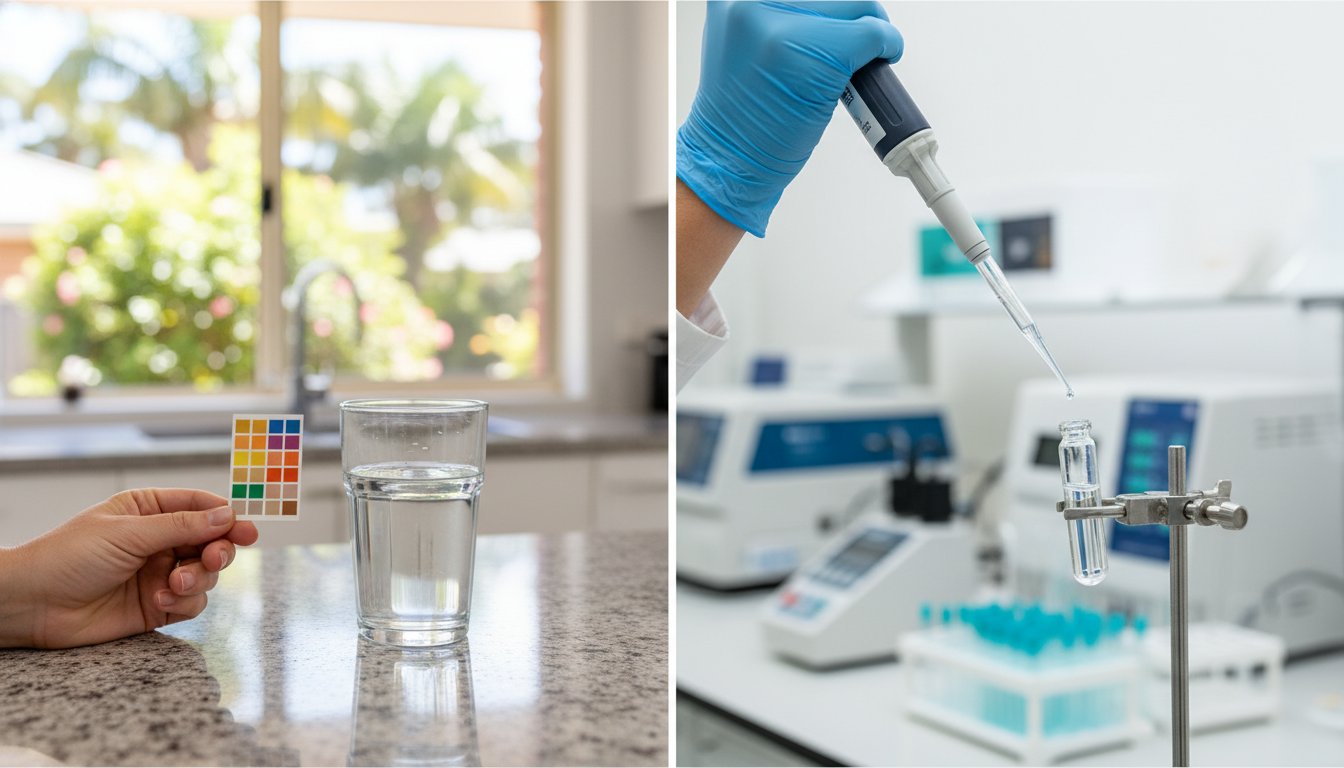
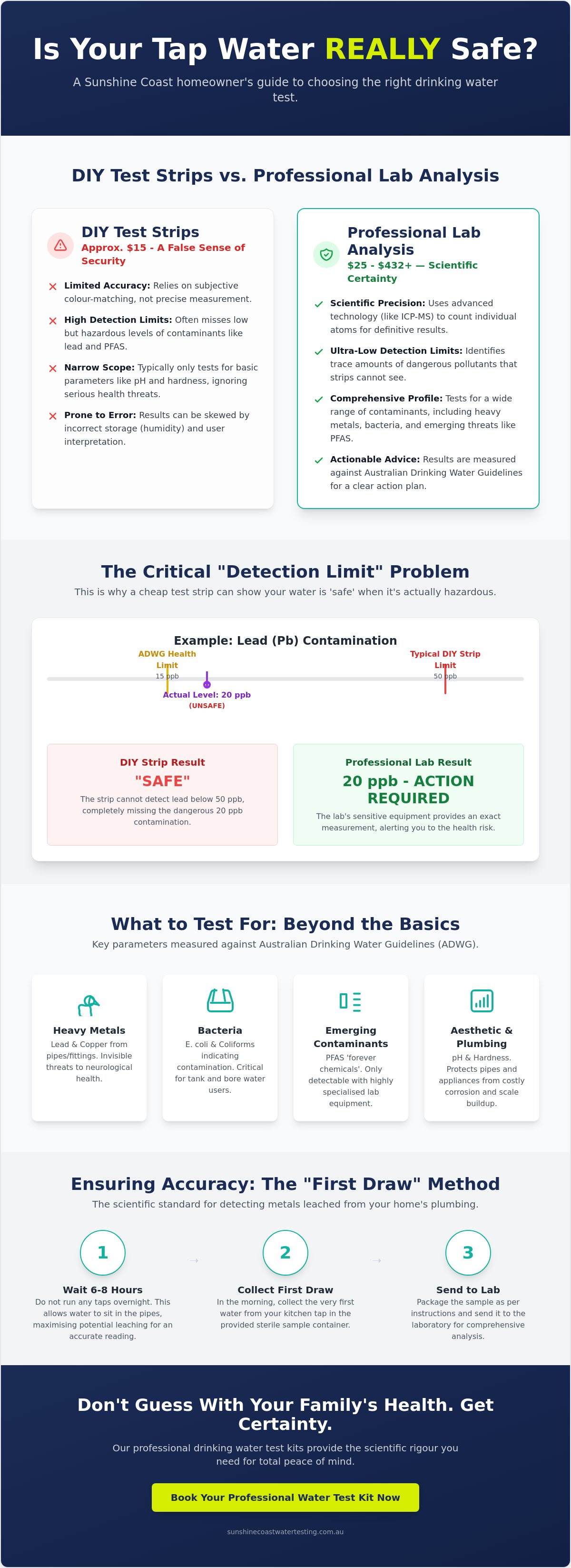
Choosing between a $20 packet of strips and a professional drinking water test kit comes down to what you're trying to achieve. DIY strips rely on a basic chemical reaction that changes the colour of a pad. You then match that colour against a printed chart. It’s quick, but it’s rarely precise. In contrast, a professional kit is a collection tool for Inductively Coupled Plasma Mass Spectrometry (ICP-MS). This sophisticated equipment doesn't just look for a colour change; it counts individual atoms to provide a definitive result.
The biggest hurdle with DIY kits is the "Detection Limit" problem. A strip might only change colour once lead reaches 50 parts per billion (ppb). However, the Australian safety threshold is much lower. You could have 20 ppb of lead in your glass—enough to be a health concern—and the strip would still show a "safe" negative result. Professional laboratory analysis identifies these low but hazardous concentrations that DIY methods simply can't see. Using a professional service is essentially a standard drinking water test that treats your home as an extension of the lab.
Storage is another silent killer of DIY accuracy. These strips are highly sensitive to humidity and heat. If they've been sitting on a hardware shop shelf or in your kitchen cupboard for six months, the reagents can degrade. This leads to skewed results that don't reflect the reality of your water. Professional kits avoid this by using sterile, vacuum-sealed containers designed solely for sample integrity. When you follow an EPA guide to home water testing, you'll see that the focus is always on the quality of the collection and the rigour of the lab, not a five-second dip-and-read.
The Accuracy Gap: Why Precision Matters
A "positive" or "negative" result for heavy metals isn't enough to make a decision about your home. You need to know the exact concentration to determine if you need a simple carbon filter or a more complex reverse osmosis system. DIY bacteria tests are particularly risky. They often require specific incubation temperatures to work. If your kitchen isn't exactly 35°C for 24 hours, you might get a false negative for E. coli. Professional labs provide a "Certificate of Analysis," which is a legal-grade document that removes all the guesswork.
Cost vs. Value: The Real Price of a Wrong Result
A cheap kit is expensive if it gives you a false sense of security. If a $15 strip says your water is fine when it actually contains high levels of copper or PFAS, the long-term cost to your health and plumbing is far higher than the price of a lab test. Peace of mind comes from knowing your data is backed by scientific instruments, not a subjective colour match. If you want to be certain about what's in your tap, it's worth the investment to book a professional water test and get results that actually make sense.
Essential Parameters: What Your Kit Should Actually Be Testing
A comprehensive drinking water test kit should do more than just tick boxes. It needs to align with the Australian Drinking Water Guidelines (ADWG) to give you a true picture of your home's safety. While many retail kits list dozens of parameters, the most critical ones for Australian households often involve heavy metals that leach from plumbing. Lead, copper, and nickel are the frequent offenders here. For instance, the current action level for lead is 15 parts per billion (ppb). If your kit doesn't have the sensitivity to measure down to these minute levels, it's not providing a real safety check.
Beyond toxic metals, your kit must assess the "health" of your plumbing system. We look closely at pH and hardness. Is your kettle furring up or are you seeing blue-green stains on your tiles? If your water is too acidic (low pH), it becomes corrosive, slowly eating away at your copper pipes and brass fittings. This can lead to copper levels exceeding the action level of 1.3 parts per million (ppm). On the other hand, high hardness leads to scale build-up. This reduces the efficiency of your hot water system and can eventually kill household appliances. These parameters might be classed as aesthetic concerns, but the long-term financial impact on your home is very real.
Chemical and Physical Properties
Total Dissolved Solids (TDS) is a vital baseline measurement. It represents the total concentration of dissolved substances in your water, revealing whether your source is relatively pure or heavily mineralised. In areas like the Sunshine Coast hinterland, we also keep a close eye on iron and manganese. These elements are the usual culprits behind brown or black staining in sinks and that unpleasant metallic taste in your morning tea. If you're near agricultural land, your kit should also include nitrate and nitrite. The ADWG sets a health limit of 50 mg/L for nitrates to protect vulnerable groups like infants, making this essential for rural properties.
Microbiological Threats: Beyond the Naked Eye
For those of us relying on rainwater tanks, microbiological analysis is the single most important test. Bacteria don't change the look or smell of your water, but they can cause immediate illness. We distinguish between Total Coliforms and E. coli. Total Coliforms are common in the environment and often indicate that your tank needs a good clean. However, E. coli is a definitive marker of faecal contamination. Whether it's from bird droppings on the roof or a stray possum in the gutters, even the best-maintained tank systems can be compromised by local wildlife. A professional kit ensures these pathogens are identified before they reach your tap.
Step-by-Step: How to Take a Scientific Water Sample at Home
Collecting a sample is the most critical part of the process. If you contaminate the bottle or use the wrong technique, even the most expensive drinking water test kit will produce misleading data. Professional laboratory analysis requires a "representative sample," which means the water in the bottle must perfectly match the water you actually drink. To achieve this, we use two distinct sampling methods depending on what we're looking for: the First Draw and the Flushed Sample.
The First Draw technique is essential for detecting heavy metals like lead and copper that leach from your home's internal plumbing. To do this correctly, the water must sit stagnant in your pipes for at least 6 hours; usually, the first thing in the morning is best. You place the sterile bottle under the tap and catch the very first drop that comes out. This captures the highest concentration of metals that have migrated from your pipes into the water overnight. If you run the tap before sampling, you'll wash those contaminants away and get a false sense of security.
The Flushed Sample method is used to test the quality of the incoming water supply from the council main or your rainwater tank. For this test, you should run the tap at a steady flow for 2 to 3 minutes before collecting the sample. This clears out the water that has been sitting in your household pipes and brings in a fresh sample directly from the source. By using both methods, you can determine if a water quality issue is caused by the water itself or by the pipes inside your walls.
Preparing Your Sampling Point
Always choose the kitchen tap for your primary sample. It’s the outlet most frequently used for drinking and cooking. Before you start, you must remove any aerators, mesh screens, or point-of-use filters attached to the tap. These components often trap sediment and biofilm which can cause a "false positive" for bacteria. Clean the tap nozzle with an alcohol wipe or a mild bleach solution to ensure you aren't introducing external bacteria into the sample. Once the bottle is open, follow the "no-touch" rule: never touch the inside of the cap or the rim of the bottle with your fingers.
Handling and Dispatching Your Sample
Timing is everything in water science. Microbiological samples are highly perishable and should ideally reach the laboratory within 24 hours of collection. If the sample sits on a hot kitchen bench for too long, any bacteria present will multiply rapidly, making the results inaccurate. Place your samples in a cooler bag with an ice pack immediately after collection. Every professional kit includes a "Chain of Custody" form. This is a legal-grade document that tracks the sample from your home to our facility, ensuring the integrity of your data. To get started with a professional-grade analysis, you can book a water test kit delivery today.
Beyond the Numbers: Getting Clear Results and Practical Advice
A raw data sheet from a laboratory can often look like a foreign language. While a drinking water test kit gives you the tools to collect a sample, the true value lies in what happens after the analysis is finished. We believe that a list of chemical symbols and decimal points is only half the service. The other half is interpretation. You shouldn't need a degree in chemistry to understand if your morning coffee is safe for your family. Our goal is to provide reports that actually make sense, turning complex science into a clear roadmap for your household safety.
This is where we differentiate ourselves from impersonal, data-heavy competitors. We follow a mission statement of being "More Than Just Numbers on a Page." If a result shows an issue, we don't just flag it; we explain what it means for your health and your home's infrastructure. It’s about providing peace of mind through transparency and local expertise. Whether you're on the Sunshine Coast or further afield, you deserve a partner who prioritises human understanding over raw scientific data.
Interpreting Your Water Analysis Report
When you receive your water analysis, the first things to look for are "Exceedances." These are results that fall outside the Australian Drinking Water Guidelines (ADWG) benchmarks. Some high numbers, like a slightly elevated TDS (Total Dissolved Solids), might only affect the "mouthfeel" or taste of the water. However, some very low numbers are critical. For instance, finding even a tiny trace of E. coli is an immediate red flag that requires urgent attention. The Limit of Reporting (LOR) is the smallest concentration a lab can reliably detect. If a contaminant is listed as "below LOR," it means the equipment found no detectable trace of it at that specific sensitivity level.
Next Steps: From Analysis to Action
A professional report is your best defence against overspending on unnecessary equipment. We often see homeowners buy expensive filtration systems before they’ve even used a drinking water test kit to see what they're actually trying to remove. This is a costly mistake. You wouldn't take medicine without a diagnosis, so don't treat your water without a lab report. Whether you need a simple sediment filter for a tank in Noosaville or a sophisticated system to handle heavy metals, the data should always drive the decision.
Once you have your results, you can make an informed choice based on facts, not high-pressure sales pitches. We provide the practical advice you need to fix the problem, whether that involves cleaning a rainwater tank, replacing a corroded pipe, or installing a specific filter. Don't leave your health to guesswork. Book your professional water test kit today for results that actually make sense.
Secure Your Home’s Safety with Scientific Certainty
Relying on a basic colour-change strip might give you a quick answer, but it rarely gives you the right one. We've explored how the "Detection Limit" problem means DIY methods often miss hazardous levels of lead or bacteria that only sophisticated lab equipment can catch. By choosing a professional drinking water test kit, you move beyond indicative screening and into the realm of definitive, legal-grade analysis. Using the First Draw sampling technique ensures you're testing what actually ends up in your glass, not just what's at the mains.
Your peace of mind shouldn't be buried under a mountain of confusing data. Our NATA-accredited laboratory analysis provides comprehensive screening for heavy metals and bacteria, but we don't just stop at the numbers. You'll receive easy-to-read reports paired with practical advice on what to do next. Don't leave your family's health to a five-second dip test. Order Your Professional Drinking Water Test Kit today and get the clear results you deserve. It's time to treat your water with the scientific rigour it requires.
Frequently Asked Questions
Is a home drinking water test kit as accurate as a lab test?
No, a standard DIY drinking water test kit is a screening tool, while professional lab analysis is a definitive measurement. Most retail strips only indicate if a contaminant is present at high levels. Professional laboratory equipment, such as ICP-MS, detects invisible threats at concentrations as low as 1 part per billion (ppb), providing the precision needed for genuine safety.
How often should I test my home drinking water?
You should test private water supplies, such as rainwater tanks or bores, at least once every 12 months. For those on Sunshine Coast town water, a test every 2 to 3 years is generally sufficient unless you notice a change in the colour, taste, or smell of your tap water. Regular testing is the only way to track changes in your water chemistry over time.
What should I test for if I have a rainwater tank?
Microbiological safety is the top priority for tank water users. Your drinking water test kit should specifically check for E. coli and Total Coliforms to ensure no faecal contamination from wildlife has entered the system. It's also wise to check pH and lead levels, especially if you have an older roof or metal gutters that could leach minerals into your supply.
Can a water test kit detect lead and other heavy metals?
Professional kits detect lead, copper, and nickel with high accuracy, but most DIY strips fail this task. The Australian Drinking Water Guidelines (ADWG) set the lead action level at 15 ppb. Many shop-bought strips have a detection limit of 50 ppb or higher, meaning they could show a "safe" result even when your water exceeds national health limits.
Do I need a different kit for bore water analysis?
Yes, bore water requires a more comprehensive analysis than standard tap water. Ground water often contains high levels of iron, manganese, and hardness that can damage your appliances and stain your laundry. A specialised bore kit measures these aesthetic concerns along with Total Dissolved Solids (TDS) to help you choose the right treatment or filtration system for your property.
What happens if my water test results show contamination?
We provide a clear report that translates your results into a practical action plan. If a parameter exceeds the ADWG limits, we'll explain what it means and suggest the next steps, such as shock-chlorinating your tank or installing a specific carbon filter. You won't be left with just a list of confusing numbers; you'll have a path forward to fix the issue.
How long does it take to get results from a professional water test kit?
You can expect to receive your results within 5 to 10 business days after the laboratory receives your sample. This timeframe allows for the necessary microbiological incubation periods and the rigorous chemical analysis required for NATA-accredited reporting. We prioritise accuracy over speed to ensure your data is reliable and actually makes sense for your household safety.
Can I use a swimming pool test kit for my drinking water?
No, swimming pool kits are designed for a completely different purpose and are unsuitable for testing potability. Pool kits measure high concentrations of chlorine and pH to prevent algae growth and skin irritation. They cannot detect heavy metals, bacteria, or the trace chemical contaminants that determine if water is safe to drink over a lifetime.

Article by
Stephen McDougall
Stephen McDougall is the owner of Pristine Water Systems Sunshine Coast and Sunshine Coast Water Testing, specialising in water quality, filtration, and tank systems. He is known for delivering clear, easy-to-understand advice and practical solutions to help clients maintain safe, reliable water.
Disclaimer
The information provided in this article is for general guidance only and is not a substitute for professional water testing or site-specific advice. Water quality can vary between properties. For accurate results and recommendations, we recommend professional testing and assessment.