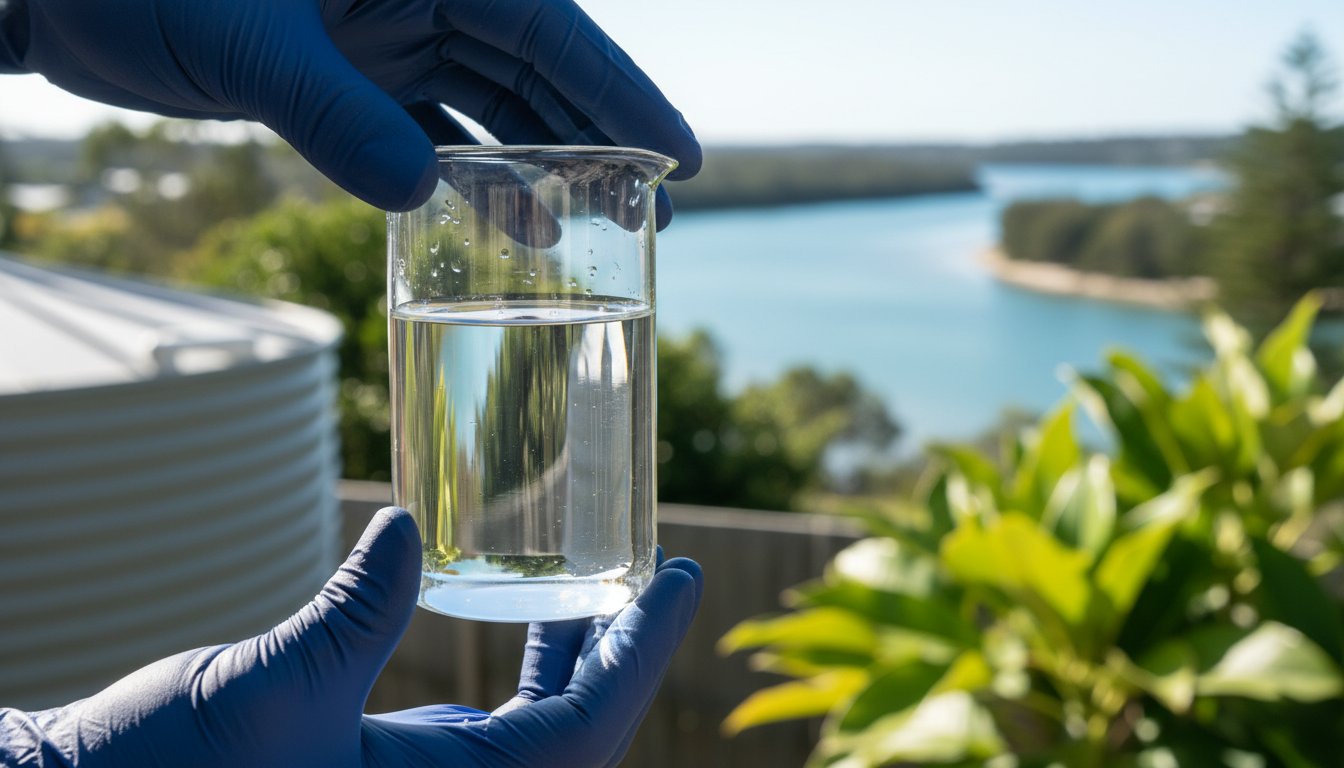
Microbiological Analysis: A Complete Guide to Ensuring Water Safety
How can you be certain the water in your glass is actually safe when the most dangerous contaminants are completely invisible? While your water might look crystal clear, it could still be harbouring harmful pathogens that a simple visual check will never catch. For many residents on the Sunshine Coast relying on tank or bore water, the fear of E. coli is a constant, underlying worry. We understand that you want to keep your household safe without getting bogged down in confusing scientific jargon or laboratory codes.
Professional microbiological analysis is the only reliable way to identify these hidden risks and ensure your drinking supply meets Australian health standards. You deserve to know exactly what’s in your water without needing a degree in science to read the results. In this guide, we'll show you how to organise a professional test, what those numbers actually mean for your health, and when you should prioritise testing your rainwater or bore. We’re here to provide local testing and practical advice that gives you total confidence in every drop.
Key Takeaways
- Understand why professional microbiological analysis is the only way to identify invisible pathogens in untreated sources like bores and rainwater tanks.
- Learn the critical differences between bacteria, viruses, and protozoa to better protect your household from common Australian waterborne illnesses.
- Discover why laboratory-controlled environments provide the precision and reliability that off-the-shelf home test kits simply cannot match.
- Identify the specific "trigger events" and annual schedules that signal it is time to organise a professional water check for your property.
- Gain the confidence to read your lab report and understand exactly what results mean for your water safety without needing a science degree.
Understanding Microbiological Analysis for Australian Water Supplies
What's actually living in your water? Microbiological analysis is the rigorous scientific process of identifying and quantifying harmful microorganisms in a water sample. It's the only way to find out if your supply contains bacteria, viruses, or protozoa that could cause illness. For households on the Sunshine Coast using non-treated sources like bores and rainwater tanks, this process is essential. You don't have the protection of municipal chlorine treatments; therefore, the responsibility for safety sits with the property owner.
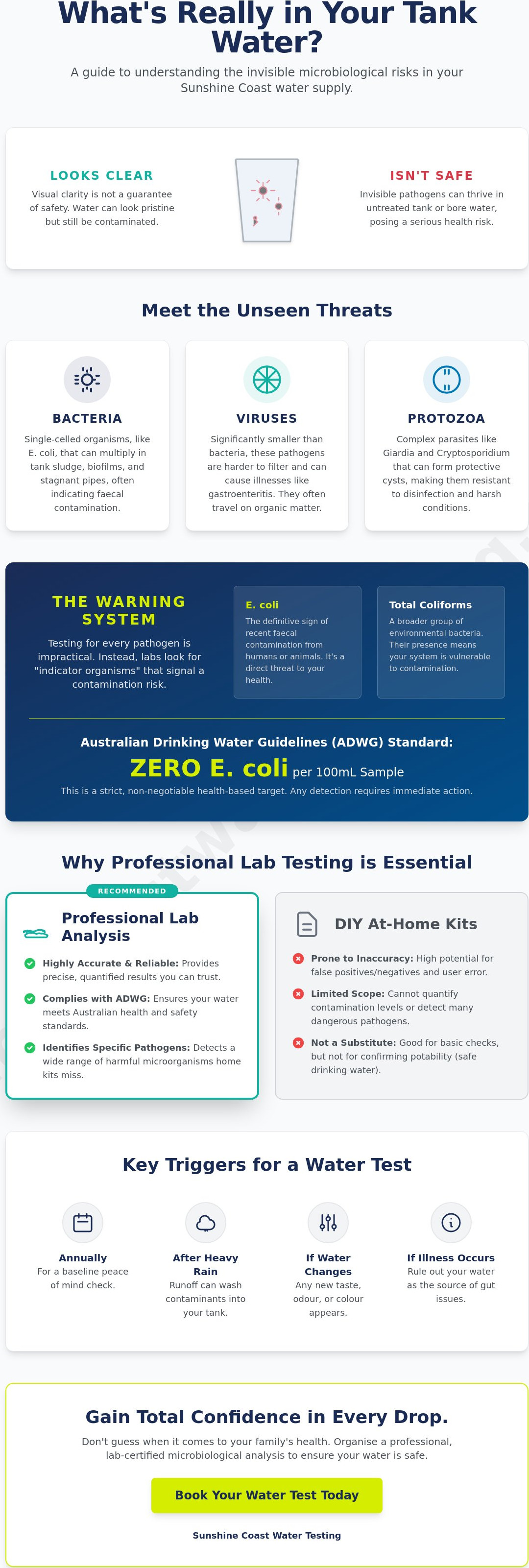
Biological contamination is a stealthy threat. It's almost always invisible, odourless, and tasteless. You can't rely on your senses to tell you if a glass of water is safe. This is why laboratories focus on "indicator organisms." These specific groups of bacteria, like Total Coliforms, act as a warning system. If they're present, it's a strong signal that more dangerous pathogens might have entered your system. A professional Bacteriological water analysis provides the data needed to take action before a health issue arises.
Why Visual Clarity is a Dangerous Deception
Is your water crystal clear? That's a great start, but it's not a guarantee of safety. A glass of water can look pristine while hosting millions of pathogenic cells. In fact, many waterborne outbreaks occur in water that looks perfectly fine to the naked eye. In rainwater tanks, the sediment and organic debris that settles at the bottom acts as a nutrient-rich breeding ground for bacteria. These sludge layers protect microorganisms from UV light and temperature changes, allowing them to thrive. Clarity is merely an aesthetic quality, while potability is a biological fact verified only in a laboratory context.
The Role of the Australian Drinking Water Guidelines (ADWG)
The ADWG serves as the national benchmark for water safety across Australia. These standards, maintained by the National Health and Medical Research Council (NHMRC), ensure that every Australian has access to safe consumption. The guidelines take a firm "zero tolerance" stance on certain pathogens. For example, E. coli must not be detected in any 100mL sample of drinking water. This strict limit exists because even a tiny amount of contamination can lead to significant health issues. Regular water testing is the primary method used by homeowners to ensure their private supply meets these legal safety requirements. We provide results that are more than just numbers on a page; they're your proof of compliance with Australian standards.
The Primary Pathogens: What Laboratory Testing Actually Looks For
What is actually living in your water supply? A professional microbiological analysis identifies the invisible threats that standard physical filters often miss. We categorise these biological risks into three main groups: bacteria, viruses, and protozoa. Each group behaves differently and requires specific detection methods. Bacteria are single-celled organisms that can thrive in stagnant plumbing. Viruses are significantly smaller and often hitch a ride on floating organic matter. Protozoa are complex parasites that survive harsh conditions by forming protective shells.
Contamination doesn't happen in a vacuum. On the Sunshine Coast, heavy tropical downpours frequently wash bird and wallaby waste from rooftops directly into rainwater tanks. Old, corroded galvanised pipes can also harbour biofilms where harmful colonies multiply undisturbed. The Australian Drinking Water Guidelines state that drinking water should contain no microorganisms that pose a risk to human health. If left untreated, these biological hazards cause everything from mild gastroenteritis to severe dehydration and long-term gut issues.
E. coli and Total Coliforms: The Indicator Organisms
Testing for every single known pathogen is slow and prohibitively expensive. Instead, laboratories look for "indicator organisms." We use Escherichia coli (E. coli) as the gold standard for detecting recent faecal contamination. If E. coli appears in a 100mL sample, it's a certainty that waste from humans or animals has entered your water. Total Coliforms represent a broader group of bacteria found in the environment. While not all are dangerous, their presence indicates your system is vulnerable to outside influence or that your disinfection process isn't working. Our laboratory cultures these samples for 24 to 48 hours to observe colony growth and provide a definitive count.
Beyond Bacteria: Viruses and Protozoa
Bacteria aren't the only concern for local property owners. Protozoa like Giardia and Cryptosporidium are common risks in tank water across Noosaville and the hinterland. These organisms are notoriously tough. They often resist standard chlorine disinfection because of their thick, cyst-like outer walls. This resilience makes a detailed microbiological analysis essential for anyone not on a treated town supply. To get a full picture of your household safety, remember that heavy metals testing often complements these biological checks by identifying chemical risks that bacteria tests won't catch. If you haven't checked your levels in the last 12 months, it's a good time to book a water test for your peace of mind.
Laboratory Analysis vs Home Test Kits: Ensuring Accuracy
Is a $20 kit from the hardware store enough to protect your family? While off-the-shelf DIY water testing kits have become popular for quick checks, they often create a false sense of security. Reliable microbiological analysis requires more than just a colour-changing strip or a basic vial left on a kitchen bench. Precision matters when you're dealing with invisible pathogens that can cause serious illness.
Professional laboratories use incubator-controlled environments to maintain a steady 35°C or 44.5°C, depending on the specific bacteria being targeted. Home kits rely on ambient room temperature, which fluctuates wildly in the Queensland heat. If the temperature isn't perfect, bacteria might not grow at all, leading to a dangerous "false negative." You think your water is safe, but the test simply failed to detect the hazard because the conditions weren't right.
The Limitations of DIY Bacterial Tests
Most home kits provide a simple "yes/no" result. They don't tell you the concentration of the bacteria or the specific type of contamination. Knowing you have "some" bacteria isn't enough to decide if you need a new filtration system or just a tank clean. DIY reagents also have a limited shelf-life. A kit that has sat in a warehouse for 12 months often loses the sensitivity needed to catch low-level but harmful pathogens.
- No quantification: You won't know if the risk is a minor spike or a severe health hazard.
- Contamination risks: It's incredibly easy to accidentally contaminate a DIY sample during the testing process.
- Zero context: These kits don't provide the "Practical Advice" you need to fix the problem.
The Role of Scientific Rigour and Accreditation
Choosing a professional laboratory ensures your results are legally and scientifically defensible. This is vital if you're a landlord, a business owner, or simply a concerned parent. We follow standardised methods to ensure every test is repeatable and accurate. You get a report that provides more than just numbers on a page; it gives you a clear path forward.
For a thorough check of your property, consider the Standard Drinking Water Test for comprehensive results. We focus on delivering data that actually makes sense so you can take the right action immediately. Our microbiological analysis identifies the exact nature of the risk, backed by the rigour of a controlled laboratory environment. Don't leave your health to a cheap plastic strip when professional certainty is available right here on the Coast.
When to Organise a Microbiological Check for Your Property
How often do you think about what’s living in your water tank? If you’re like most Sunshine Coast residents, it’s probably only when the water starts to smell or look a bit off. Waiting for visible signs is a gamble you don't need to take. For private water supplies like bores and rainwater tanks, an annual microbiological analysis is the minimum standard for safety. This regular check ensures that even if your water looks crystal clear, it isn't harbouring invisible pathogens like E. coli or Giardia.
If you've just moved into a new home in Noosaville or the surrounding hinterland, don't assume the previous owners maintained the system correctly. You should organise a test immediately if you are taking over an existing tank or bore. Use this quick checklist for new property owners:
- Check for overhanging branches or heavy bird activity near the roof catchment.
- Inspect the tank for cracks, light leaks, or unsecured lids.
- Verify if a "first flush" diverter is installed and functioning.
- Request a professional test to establish a baseline for your water quality.
Critical Triggers: Floods, Maintenance, and Seasonal Changes
In Australia, our weather moves from extreme dry to intense wet very quickly. These seasonal shifts directly impact your microbial load. During a heavy "first flush" after a dry spell, the rain washes months of accumulated dust, animal droppings, and debris straight into your system. If your property experiences any level of inundation or flooding, a microbiological analysis is mandatory before you resume drinking the water. Floodwaters often carry sewage and agricultural runoff that can overwhelm standard filtration systems.
Maintenance work is another common trigger. If you've recently replaced a pump, repaired a pipe, or cleaned out your tank, you've potentially introduced new bacteria into the closed system. Any change in the colour, taste, or smell of your water should be treated as a red flag. It's always better to be certain than to guess when it comes to your family's health.
Sampling Procedure: How to Collect a Contamination-Free Specimen
The accuracy of your results depends entirely on how you collect the sample. We provide "More Than Just Numbers on a Page", but we need a clean sample to give you those clear results. Follow these steps to ensure your specimen isn't contaminated by the tap itself or your hands:
- Select the right tap: Use a clean, non-leaking metal tap, preferably the one used most for drinking water.
- Sterilise: Clean the tap mouth with an alcohol wipe or a small flame to kill any surface bacteria.
- Flush: Run the water on high for at least 2 to 3 minutes to clear the stagnant water from the pipes.
- Fill: Carefully unscrew the sterile bottle cap. Do not touch the inside of the cap or the rim of the bottle. Fill it to the line and seal it immediately.
- The Cold Chain: Bacteria multiply fast in the Queensland heat. Place your sample in a cooler bag with an ice pack and deliver it to our Noosaville lab within 6 to 24 hours of collection.
Local Testing. Clear Results. Practical Advice. We make the process simple so you can get back to enjoying your property with total peace of mind.
Ensure your water is safe today. Book your microbiological water test now.
Interpreting Your Results and Taking Practical Action
Receiving your microbiological analysis report shouldn't feel like sitting a chemistry exam. Most people skip straight to the results column, looking for two specific phrases: "Detected" or "Not Detected." If your report shows "Not Detected" for E. coli and Thermotolerant Coliforms, your water meets the primary safety standards for Australian drinking water. However, seeing "Detected" isn't a reason to panic. It's simply a data point that tells us your current filtration or treatment process has a gap. At Sunshine Coast Water Testing, we believe in providing Clear Results and Practical Advice, helping you move from uncertainty to a clear solution.
Deciphering the Data: What the Numbers Mean
Your report will likely list results in CFU/100mL, which stands for Colony Forming Units per 100 millilitres of water. For E. coli, the Australian Drinking Water Guidelines (ADWG) are strict; there should be 0 CFU per 100mL. If your report shows high Total Coliform counts but zero E. coli, it usually indicates environmental bacteria from soil or decaying leaves rather than faecal contamination. This is a common finding in nearly 70% of unmaintained rainwater tanks in Noosaville and the surrounding hinterland. Our reports are designed to be More Than Just Numbers on a Page; we explain exactly how these figures impact your daily water use.
Immediate Steps if Your Water Fails the Safety Test
If your water fails a safety test, you need to take immediate action to protect your household. Follow the standard "Boil Water Alert" protocol: bring all drinking and tooth-brushing water to a rolling boil for at least 60 seconds. This kills 99.9% of active pathogens. For a permanent fix, consider these three practical options:
- UV Sterilisation: Install a UV system to neutralise bacteria without changing the water's taste or odour.
- Chlorination: Use a calculated dose of chlorine to disinfect the entire storage tank and pipework.
- Tank Cleaning: Remove the accumulated sludge and organic matter that acts as a breeding ground for bacteria.
Once you've implemented a solution, it's vital to verify that it's actually working. You can book a water test to confirm your system is back to safety. We don't just hand you a page of data; we help you organise a plan to keep your family's water clean and safe. A "fail" result isn't a catastrophe; it's the first step toward a more reliable and secure water supply for your home.
Secure Your Property's Health With Expert Water Testing
Is your water supply truly safe for your family? While home test kits might seem convenient, they often lack the scientific rigour required to detect dangerous pathogens. Professional microbiological analysis is the only way to ensure your water meets the strict safety standards defined by the Australian Drinking Water Guidelines. You shouldn't have to guess about your water quality; you deserve clear answers backed by laboratory precision.
At Sunshine Coast Water Testing, we believe results should be more than just numbers on a page. We provide fast, easy-to-understand laboratory reports that strip away the technical jargon. Every test result includes no-nonsense practical advice, so you know exactly what steps to take if your supply needs attention. It's about providing you with total peace of mind and a clear path forward for your property's safety.
Book your professional microbiological analysis today and take the guesswork out of your water quality. We're here to help you keep your household's most vital resource clean and reliable.
Frequently Asked Questions
Is microbiological analysis necessary for town water users?
No, town water is treated to meet the Australian Drinking Water Guidelines (ADWG) before it reaches your meter. However, a microbiological analysis is wise if you've done recent plumbing work or notice a strange smell from your taps. Old pipes in some Sunshine Coast homes can harbour bacteria despite the council's chlorination, so testing provides peace of mind.
How long does a microbiological water test take to complete?
Most tests require a 24 hour incubation period to allow bacteria to grow to detectable levels. You'll typically receive your clear, easy to read report within 2 to 3 business days of the sample arriving at our Noosaville lab. This timeframe ensures the results are accurate and reflect the true state of your household water supply.
Can I use a swimming pool test kit to check my drinking water?
No, pool kits only measure chemical levels like chlorine and pH. They won't detect harmful pathogens like E. coli or Cryptosporidium. Drinking water safety requires a professional microbiological analysis in a controlled laboratory environment. Relying on a pool kit for drinking water safety is risky and doesn't provide the practical data you need to ensure it's safe to swallow.
What happens if E. coli is detected in my rainwater tank?
Stop drinking the water immediately and boil any water used for food preparation or tooth brushing. You'll need to shock dose your tank with chlorine, following the Queensland Health guidelines of 7 grams of calcium hypochlorite per 1,000 litres of water. After treatment, clean your gutters and re-test the water to ensure the contamination is gone.
How often should I test my bore water for bacteria?
Test your bore water at least once every 12 months to ensure it remains safe. Heavy rain events, like the 200mm falls seen in some Sunshine Coast seasons, can wash surface contaminants into the groundwater. Regular testing helps you track changes in your water quality and ensures your filtration system is still doing its job effectively.
Does boiling water remove all microbiological contaminants?
Boiling water kills most bacteria, viruses, and protozoa, making it safe from a microbiological standpoint. Bring the water to a rolling boil for at least 60 seconds to ensure pathogens are destroyed. Keep in mind that boiling won't remove chemical pollutants or heavy metals; it actually concentrates them as the water evaporates during the process.
What is the difference between a chemical and a microbiological test?
A chemical test measures non-living substances like salt, iron, and pH levels. A microbiological test looks for living organisms such as bacteria and coliforms that cause immediate illness. You need both to get a full picture of your water safety, as clear water can still contain invisible, harmful bacteria that are more than just numbers on a page.
Can wildlife in my gutters affect my water test results?
Yes, animal droppings from birds or possums in your gutters are the primary cause of tank water contamination. Research shows that 95% of rainwater tank failures are linked to poor roof and gutter maintenance. Installing "first flush" diverters and cleaning your gutters every 6 months will significantly reduce the risk of a failed microbiological water test.

Article by
Stephen McDougall
Stephen McDougall is the owner of Pristine Water Systems Sunshine Coast and Sunshine Coast Water Testing, specialising in water quality, filtration, and tank systems. He is known for delivering clear, easy-to-understand advice and practical solutions to help clients maintain safe, reliable water.
Disclaimer
The information provided in this article is for general guidance only and is not a substitute for professional water testing or site-specific advice. Water quality can vary between properties. For accurate results and recommendations, we recommend professional testing and assessment.