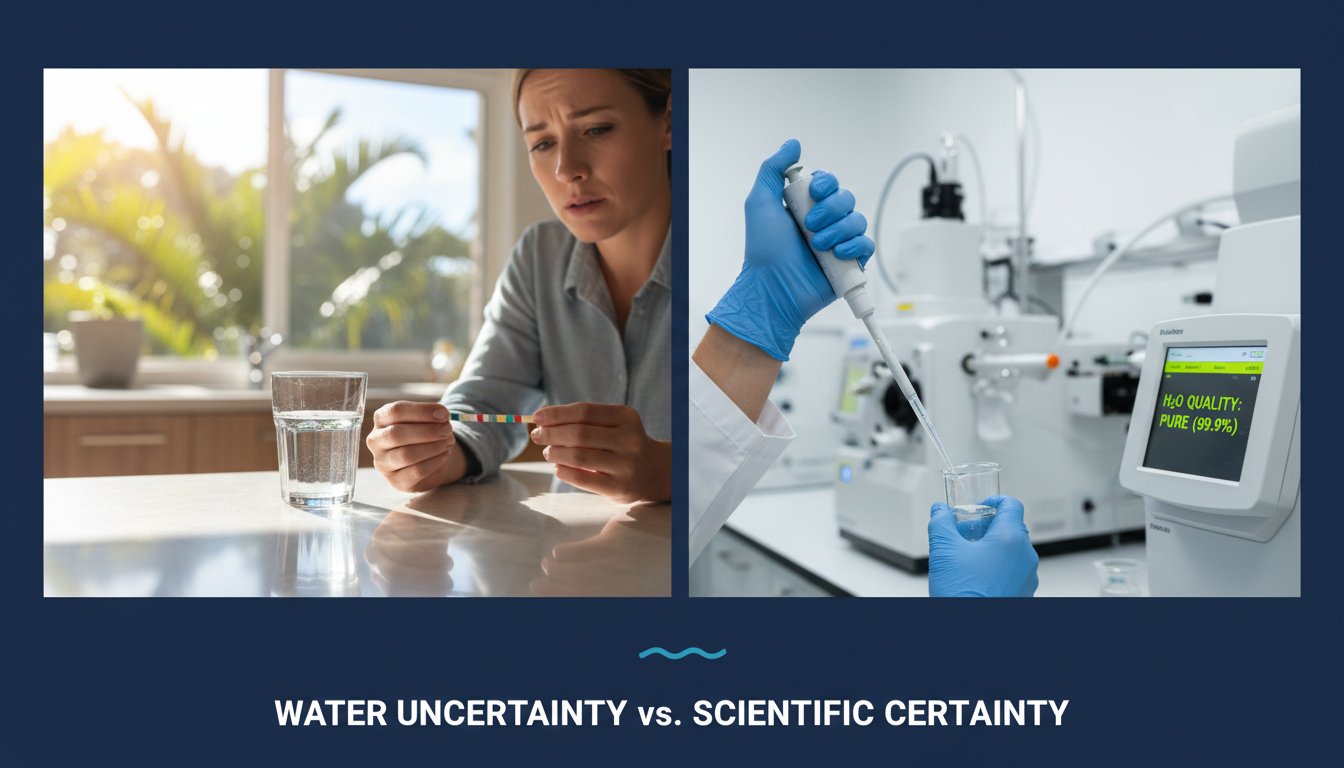
Water Testing Kits: DIY Home Tests vs. Professional Laboratory Analysis
Is that $25 strip from the local hardware store really enough to guarantee your family's health, or is it just providing a false sense of security? Most homeowners naturally want a quick, affordable way to check their tap or bore water. It's frustrating when you're staring at a colour chart, trying to figure out if a shade of pink means your water is safe or if you're dealing with lead levels that exceed the 2011 Australian Drinking Water Guidelines. Technical jargon like ppm and ppb often adds more confusion than clarity.
In this article, you'll discover the critical differences between off-the-shelf water testing kits and professional laboratory analysis. We'll show you how to move past the guesswork to ensure your household water is truly safe. We'll compare the accuracy of DIY methods against professional standards and explain how to get clear, practical advice that goes far beyond just numbers on a page.
Key Takeaways
- Learn why a "clear" result on a colour strip doesn't guarantee safety and how laboratory-grade analysis identifies risks invisible to the naked eye.
- Discover the specific limitations of off-the-shelf water testing kits and why "all-in-one" strips often fail to detect dangerous contaminants like PFAS or mercury.
- Identify the critical "red flag" scenarios where professional laboratory testing is non-negotiable to ensure your family's long-term health.
- Understand how to move beyond "numbers on a page" with practical advice that helps you make sense of your water quality and what to do next.
What are Water Testing Kits and How Do They Work?
Water testing kits are portable tools designed to identify specific chemical or biological properties in your water supply. In the Australian domestic market, particularly for the 2.3 million households that the 2021 Census identified as using rainwater tanks, these kits offer a first line of defence. They work by triggering a chemical reaction between a water sample and a specific reagent, or by using electrical conductivity to estimate mineral content. Understanding water testing procedures helps you distinguish between aesthetic issues, such as the "rotten egg" smell of hydrogen sulphide, and serious health-based toxicants like lead or arsenic that remain invisible to the naked eye.
These tools help homeowners manage their own water security without waiting for a technician. Whether you're on a suburban block in Noosaville or a rural property relying on a bore, a basic kit provides a snapshot of what's happening in your pipes. While they are useful for routine checks, it's vital to remember that a DIY kit is a screening tool rather than a definitive diagnostic instrument.
Common Types of Home Testing Kits
- Reagent Strips: These are the most common DIY tool found in hardware stores. You dip a paper strip into a sample and wait 30 to 60 seconds for a colour change. They typically measure pH, chlorine, and total hardness. They provide a "ballpark" figure but often lack the precision required for high-stakes health decisions.
- Digital TDS Testers: A Total Dissolved Solids (TDS) meter measures the electrical conductivity of the water. It provides a digital reading in parts per million (ppm). We believe in providing information that is more than just numbers on a page, so it's important to understand that a TDS meter won't detect bacteria, pesticides, or many heavy metals. It simply counts the total dissolved minerals and salts.
- Bacteria Vials: Home tests for E. coli usually function as "presence/absence" tests. You add a water sample to a vial containing a nutrient broth and let it sit at room temperature for 24 to 48 hours. If the liquid changes colour, bacteria are present.
The Appeal of the DIY Approach
Immediate results are the primary reason homeowners gravitate towards water testing kits. You don't have to wait for a lab queue or a courier. If you're checking a swimming pool or a basic garden tap, a 60-second wait is all it takes to get a general reading.
Cost-effectiveness is another major factor. Off-the-shelf kits are affordable, with basic pH strips often retailing for under A$25 at local centres. This low entry price makes them attractive for frequent, casual monitoring, even if the results don't always provide a report that actually makes sense for complex health concerns.
Convenience allows you to test your own kitchen tap or garden bore on a Sunday afternoon. There's no need to coordinate with a professional service for a simple check. However, if you need a more detailed breakdown than a strip can provide, you can book a water test with a professional laboratory to ensure your family's safety. Local Testing. Clear Results. Practical Advice.
DIY Kits vs. Laboratory Analysis: Debunking the Accuracy Myth
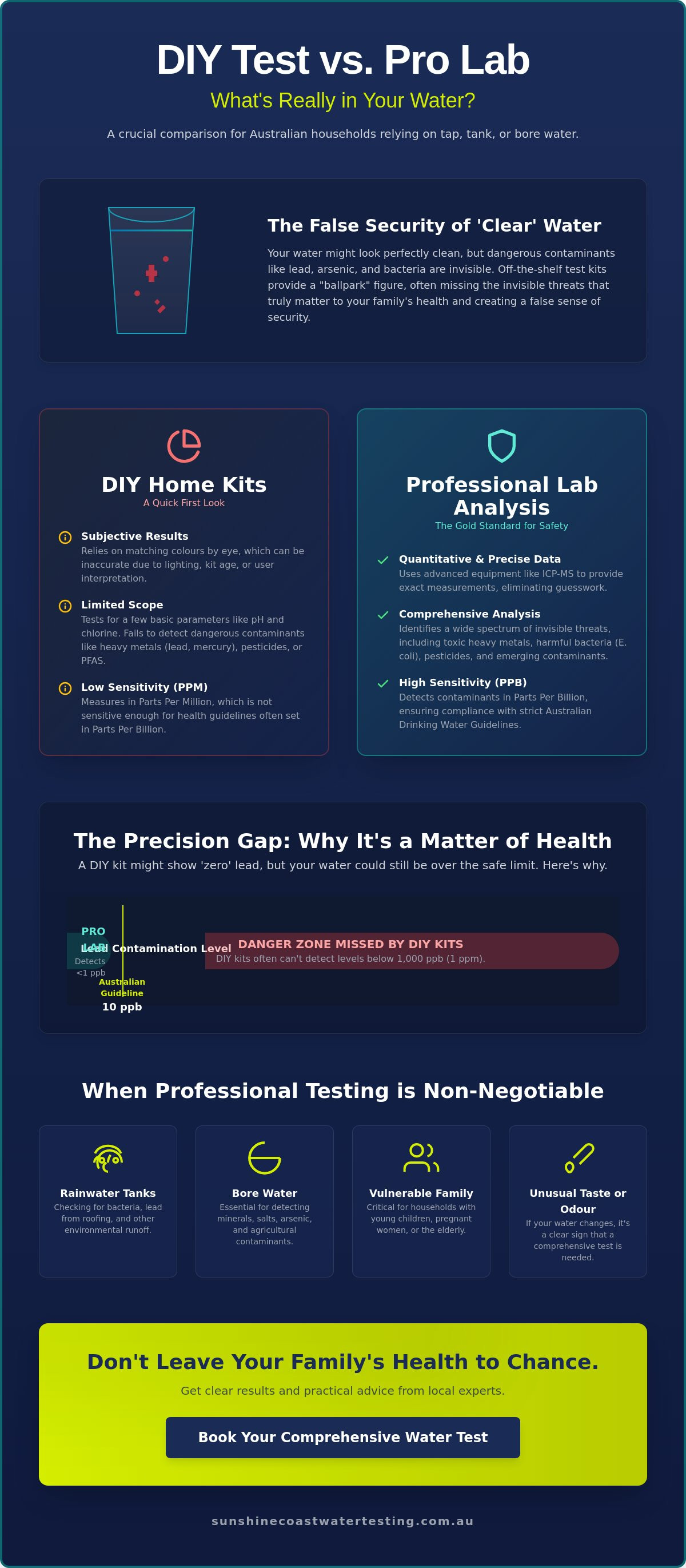
Does your tap water look crystal clear? Most homeowners assume that if water is transparent and odourless, it's safe to drink. This is a common misconception that off-the-shelf water testing kits often reinforce. While a plastic strip might change colour to show your pH is roughly neutral, it lacks the scientific sensitivity to detect invisible threats. DIY kits are screening tools; they provide a "yes or no" answer to broad questions but fail when you need precise data.
The primary issue lies in the technology. A retail kit relies on chemical reagents that produce a visual colour change. This process is subjective. Factors like the age of the kit, storage temperature, and even the lighting in your kitchen can lead to an incorrect reading. In contrast, professional laboratory analysis uses ICP-MS (Inductively Coupled Plasma Mass Spectrometry). This equipment doesn't guess; it ionises the sample and counts individual atoms to provide an exact chemical profile. It's the difference between a quick pulse check and a full hospital blood panel.
The Precision Gap
Precision is measured in scale. Most DIY water testing kits measure contaminants in parts per million (ppm). While this sounds impressive, the Australian Drinking Water Guidelines often set safety limits for heavy metals in parts per billion (ppb). For example, the health limit for lead in Australian drinking water is 0.01 mg/L. Most home strips can't reliably detect levels that low. If your kit says "zero" because it can only see ppm, you might still be consuming lead at five times the recommended safety limit.
Shelf-life also plays a massive role in the precision gap. Reagents on testing strips are highly sensitive to Queensland's humidity. A kit that has sat on a hardware store shelf for 12 months or in your laundry cupboard through a hot summer will likely produce skewed results. Laboratory chemicals are batch-tested and calibrated daily to ensure the data is legally and scientifically defensible.
Why Lab Reports "Actually Make Sense"
A professional Standard Drinking Water Test offers much more than a simple colour match. We operate on a "More Than Just Numbers on a Page" philosophy. Raw data is useless if you don't know how it affects your family or your plumbing. While a DIY kit leaves you to interpret a vague shade of green, a lab report provides a clear comparison against national health standards.
Professional interpretation removes the guesswork. We look at how different elements interact, such as how your water's hardness might be accelerating pipe corrosion. This context turns a list of minerals into a practical guide for your home. If you want to move beyond "screening" and get a definitive answer about your water quality, you can organise a professional analysis to see exactly what's in your glass.
The Invisible Risks: Why Colour Strips Often Miss the Mark
You've likely seen them online or at the local hardware store: plastic pouches promising to test for everything from arsenic to zinc in under sixty seconds. While these water testing kits offer a quick snapshot, they often lack the sensitivity required to protect your health. Many DIY strips have high detection limits, meaning they might only change colour when a contaminant is already well above safe levels. Critical substances like specific PFAS (per- and polyfluoroalkyl substances) or low-level Mercury are almost never detected by retail kits because they require sophisticated mass spectrometry equipment found only in a professional lab.
The "All-in-One" 15-parameter or 23-in-1 kits are particularly problematic. Chemistry isn't always a "set and forget" process. The reagents on these strips can interfere with one another, and the water's own pH can throw off the results entirely. If your water is naturally acidic, it can inhibit the chemical reaction needed to show the presence of other minerals. This creates a skewed result that doesn't reflect what's actually coming out of your tap.
A common objection we hear is, "My kit says it tests for Lead, so isn't that enough?" The reality is that the Australian Drinking Water Guidelines set the limit for lead at 0.01 mg/L. Most off-the-shelf water testing kits can't accurately measure concentrations that minute. They might show a negative result even if your water contains lead at levels that could cause long term health issues, especially in children. Relying on a $30 strip for heavy metal safety is a gamble that rarely pays off.
The Danger of False Negatives
A false negative occurs when your test result says a contaminant isn't there, but it actually is. This is the single biggest risk of DIY testing. If a kit misses a heavy metals issue, you'll continue drinking and cooking with that water, thinking everything is fine. This false sense of security is dangerous because it stops you from seeking the filtration or treatment you actually need. A professional lab uses calibrated instruments that detect parts per billion, providing a level of accuracy a paper strip can't match.
Microbiological Uncertainties
Testing for bacteria at home is notoriously difficult. Home kits are highly prone to "accidental positives" because it's so easy to contaminate the sample bottle during the process. Conversely, they can give you a "safe" reading if the sample isn't incubated correctly. Most DIY kits ask you to leave a vial on a windowsill for 48 hours, but sunlight and temperature fluctuations can kill off the very bacteria you're trying to find. Lab protocols involve controlled incubation at 35 degrees Celsius to ensure every pathogen is accounted for. Furthermore, home kits usually only check for "Total Coliforms," which doesn't tell you if you're dealing with harmless soil bacteria or dangerous strains like E. coli.
If you want results that actually make sense, it's time to move beyond the colour strip. You can book a professional water test on the Sunshine Coast to get the full picture of your water quality.
Practical Guide: When to Use a Kit vs. Professional Lab Testing
How do you decide if a store-bought strip is enough or if you need a scientist? Choosing between these options depends entirely on the level of risk you are willing to accept. While water testing kits offer a snapshot of basic chemistry, they cannot provide the legal or health-based certainty required for complex water sources. In Australia, the 2011 Australian Drinking Water Guidelines (ADWG) set the standard for what constitutes safe water. These guidelines cover over 200 different physical, chemical, and microbial characteristics that a simple colour-changing strip simply cannot detect.
When a DIY Kit is Useful
DIY kits are excellent tools for high-frequency, low-risk monitoring where immediate feedback is more important than laboratory precision. You should reach for a home kit in these specific scenarios:
- Pool and Spa Maintenance: Checking pH and chlorine levels weekly to prevent algae growth and skin irritation.
- Water Softener Performance: Verifying if your ion-exchange system is effectively reducing calcium and magnesium hardness.
- Basic Filtration Efficiency: Comparing tap water to filtered water to see if your carbon block filter is reducing basic chlorine tastes.
- Educational Projects: Teaching students about acidity or keeping a hobbyist aquarium balanced for tropical fish.
When Professional Lab Analysis is Essential
There are "Red Flag" situations where guessing isn't an option. If your health, property value, or livestock are involved, laboratory analysis is non-negotiable. Professional testing provides "More Than Just Numbers on a Page"; it gives you a legal record and scientific certainty.
Professional analysis is required for:
- New Bore Water Sources: Before you pump bore water into a home or use it for livestock, you must establish a baseline. This identifies heavy metals or salinity levels that could ruin your plumbing or harm animals.
- Annual Rainwater Audits: If you rely on tank water in wildlife-heavy areas of the Sunshine Coast, annual checks for E. coli and Salmonella are vital.
- Property Transactions: Buying or renting a home with an independent water supply requires a formal report to verify ADWG compliance.
- Unexplained Health Issues: If household members experience recurring gastrointestinal distress or skin rashes, you need a microbial deep-dive that water testing kits can't provide.
Establishing a "Baseline Test" is the most important step for any new property owner in Noosaville or the surrounding hinterland. This initial comprehensive screen acts as a reference point for all future tests. If a construction project starts nearby or a flood event occurs, you'll have a clear record to prove how your water quality has changed. We provide the Local Testing, Clear Results, and Practical Advice you need to manage your water with confidence.
Don't leave your family's health to a paper strip. Book a professional water test today for results that actually make sense.
Clear Results and Practical Advice: The Professional Advantage
Relying on basic water testing kits might give you a general idea of your water quality, but it rarely provides the full picture. A professional laboratory analysis is a genuine investment in your long-term health and property maintenance. At Sunshine Coast Water Testing, we take the "Trusted Local Expert" approach. This means we pair rigorous scientific data with a deep understanding of local conditions across Noosaville and the wider region. We don't just hand over a spreadsheet; we provide clarity.
The process is designed to be as easy as possible for busy homeowners. After you order your test, we handle the technical side and deliver a clear, actionable report. You won't find any high-pressure sales or endless marketing emails here. Our "No Spam" and "Practical Advice" guarantees mean you get the information you need and nothing you don't. It's about safety and integrity, not a sales pitch for expensive equipment you might not even need.
What to Expect from a Laboratory Report
A professional report offers a detailed breakdown of chemical and microbiological parameters that off-the-shelf water testing kits simply cannot detect. We compare your individual results against the Australian Drinking Water Guidelines (ADWG) health and aesthetic limits. This includes everything from pH levels and hardness to heavy metals and bacteria. Crucially, we include a summary that actually makes sense to a non-scientist. We translate the parts per million into plain English so you know if your water is safe, clean, and tastes the way it should.
Taking Action for Your Water Health
Your report is a roadmap for your home's health. If contaminants are found, you can use these precise figures to organise specific filtration or treatment solutions rather than guessing with generic filters. For homeowners on independent water supplies like bore water or rainwater tanks, regular testing is essential. Environmental factors change, and a test from 2022 won't reflect today's reality. We suggest an annual check-up to ensure your system remains effective. Don't leave your family's safety to chance. Book your professional water test today for total peace of mind.
Take Control of Your Household Water Safety
While off-the-shelf water testing kits offer a quick snapshot of basic chemistry, they simply can't match the scientific precision of a professional laboratory. Colour strips frequently miss low-level contaminants or specific bacteria that exceed the Australian Drinking Water Guidelines (ADWG) health or aesthetic limits. You shouldn't have to guess whether a slight change in hue means your water is safe for your family. Our local analysis provides the clarity you need, moving beyond simple data to deliver reports that actually make sense. We provide more than just numbers on a page; we give you a clear roadmap for what to do next.
Choosing a professional service means you're getting local expertise from people who live and work on the Sunshine Coast. We follow a strict "no spam" policy, focusing entirely on delivering practical advice that protects your health and your home's plumbing. You'll receive a detailed breakdown of your water quality that prioritises transparency over technical jargon. It's the fastest way to gain total confidence in every tap in your house. Stop wondering and start knowing with a test that's as reliable as it is easy to understand.
Book your professional water analysis for total peace of mind
Frequently Asked Questions
Is a home water testing kit as accurate as a laboratory test?
Home water testing kits aren't as accurate as a professional laboratory analysis. While a DIY kit gives you a broad range for common issues like pH or chlorine, a NATA-accredited lab uses calibrated equipment to detect contaminants at parts per billion. For example, a kit might show a "safe" colour for lead, but a lab can detect 0.001mg/L, ensuring your family stays within the Australian Drinking Water Guidelines.
Can water testing kits detect E. coli and other harmful bacteria?
Some water testing kits can detect the presence of E. coli, but they won't give you a specific count. These "presence/absence" tests often take 24 to 48 hours to show a colour change. If you're on the Sunshine Coast using tank water, a lab test is much safer because it quantifies the exact colony-forming units (CFU) per 100ml, giving you a clearer picture of the contamination level.
How often should I test my home drinking water source?
You should test your private water supply at least once every 12 months. If you rely on bore water or rainwater tanks in Noosaville, Queensland Health recommends more frequent checks after heavy rainfall or local flooding. Regular testing ensures that seasonal changes or local run-off haven't introduced new contaminants into your household pipes, giving you year-round peace of mind.
Do water testing kits expire or lose their effectiveness?
Yes, water testing kits typically expire within 12 to 24 months of their manufacture date. The chemical reagents in test strips or liquid drops are sensitive to heat and humidity, which are common in our local climate. Using an out-of-date kit leads to false negatives or inaccurate readings, so always check the "use-by" date on the packaging before starting your DIY analysis.
What is the most important thing to look for in a water analysis report?
The most critical part of a report is how your results compare to the Australian Drinking Water Guidelines (ADWG). A professional report should be more than just numbers on a page; it should clearly highlight any parameters that exceed health or aesthetic limits. Look for the "Guideline Value" column to see exactly where your water sits in relation to national safety standards.
Can I use a DIY kit to test my bore water for irrigation?
You can use a DIY kit for basic irrigation checks, but they often miss critical minerals like iron or manganese. High salinity or "hard" water can ruin garden soil over time. A professional bore water analysis provides a detailed breakdown of the Sodium Adsorption Ratio (SAR). This specific calculation tells you if the water will eventually kill your lawn or clog your irrigation nozzles.
How much does professional laboratory water testing cost compared to a kit?
Basic DIY water testing kits usually cost between A$20 and A$100 at local hardware stores. In contrast, professional laboratory testing in Australia typically ranges from A$150 for a standard health check to A$450 for comprehensive chemical screening. While the upfront cost is higher, the lab provides 100% certainty and a legal document that a simple plastic strip cannot match.
What should I do if my water test kit shows a positive result for lead?
If your kit shows lead, stop drinking the water immediately and book a professional laboratory test to confirm the finding. DIY kits are prone to false positives from other metals. A lab will identify if the lead is coming from your pipes or the source. Contact a licensed plumber to inspect any brass fittings or lead soldering if the lab confirms levels above 0.01mg/L.

Article by
Stephen McDougall
Stephen McDougall is the owner of Pristine Water Systems Sunshine Coast and Sunshine Coast Water Testing, specialising in water quality, filtration, and tank systems. He is known for delivering clear, easy-to-understand advice and practical solutions to help clients maintain safe, reliable water.
Disclaimer
The information provided in this article is for general guidance only and is not a substitute for professional water testing or site-specific advice. Water quality can vary between properties. For accurate results and recommendations, we recommend professional testing and assessment.