Australian Drinking Water Guidelines for Private Sources: A Homeowner’s Guide
Who is actually responsible for the safety of your family's drinking water if it doesn't come from a council pipe? If you live in a beautiful pocket of the Sunshine Coast like Doonan or Tinbeerwah, you likely rely on a rainwater tank or a bore. Unlike town water, the responsibility for monitoring your supply sits squarely on your shoulders. Deciphering the 1,200-page australian drinking water guidelines for private sources can feel like a full-time job. It's completely normal to feel a bit overwhelmed by technical talk of PFAS, E. coli, or pH levels when you simply want a clean, refreshing glass of water for your household.
This guide simplifies those national standards into plain English so you can manage your home water with confidence. You'll learn what the guidelines actually mean for your specific setup and how to identify potential issues without the stress. We believe that water testing identifies the problem, and the solution comes next. Local experts at Sunshine Coast Water Testing provide easy-to-read summaries of your results. If your supply doesn't meet Australian Drinking Water Guidelines and should be addressed, Pristine Water Systems Sunshine Coast can help with professional filtration or tank cleaning. From Noosa to Pomona, let's ensure your private water source meets the grade.
Key Takeaways
- Learn how the australian drinking water guidelines for private sources act as a national benchmark to help you manage your own tank or bore supply effectively.
- Discover the difference between health-based parameters that protect your family and aesthetic factors that affect the taste of your water and the lifespan of your plumbing.
- Understand your legal role as the water authority for your property and why relying on the look and smell of your water can be a significant risk.
- Master a simple process for collecting laboratory-grade samples to ensure your testing results are accurate and reliable.
- See how a plain-English summary of your data bridges the gap between identifying an issue and finding a practical solution for your home.
Understanding the Australian Drinking Water Guidelines (ADWG) for Homeowners
If you've ever tried to download the official Australian Drinking Water Guidelines, you've likely found a document longer than a thick novel. Developed by the National Health and Medical Research Council (NHMRC), this framework ensures that the water we use for drinking, cooking, and bathing is of a high standard. For homeowners in areas like Cooroy or Doonan, the australian drinking water guidelines for private sources provide the essential roadmap for managing self-sourced water. While these guidelines are used by major utilities to manage city supplies, they aren't actually mandatory laws that a residential homeowner must follow. Instead, they serve as a vital safety benchmark to help you understand if your water quality is where it should be.
The Role of the NHMRC in Water Safety
The NHMRC doesn't just write these rules once and forget them. They use a "rolling revision" process, which means the guidelines are constantly updated as new scientific evidence emerges. For instance, recent updates in June 2025 and ongoing consultations into June 2026 have refined the standards for substances like PFAS (forever chemicals), nickel, and ammonia. This ensures that the benchmarks stay relevant to modern environmental challenges. State health departments across the country look to these guidelines to define what "potable" water actually looks like. Understanding Water supply and sanitation in Australia helps clarify how these national standards filter down to local health advice for your specific property.
Why Private Sources Require Different Management
If you're on a town supply, a large utility handles the filtering, testing, and monitoring. However, if you rely on a rainwater tank in Tinbeerwah or a bore in Pomona, you are effectively your own water authority. Private sources are open to the environment. This makes them susceptible to runoff, local wildlife, or mineral changes in the soil. Without the constant monitoring provided to city dwellers, it's easy for contaminants to go unnoticed.
The ADWG helps you bridge this gap by providing clear targets for your water quality. Sunshine Coast Water Testing helps homeowners apply these complex standards to their own backyard through professional water testing on the Sunshine Coast. We believe that water testing identifies the problem; the solution comes next. If a test shows that your supply does not meet Australian Drinking Water Guidelines and should be addressed, you can look to specialists like Pristine Water Systems Sunshine Coast for professional filtration or tank cleaning. Using the australian drinking water guidelines for private sources isn't about following a government rule; it's about having the same peace of mind as anyone connected to a city main.
Health vs. Aesthetic Guidelines: What the Parameters Actually Mean
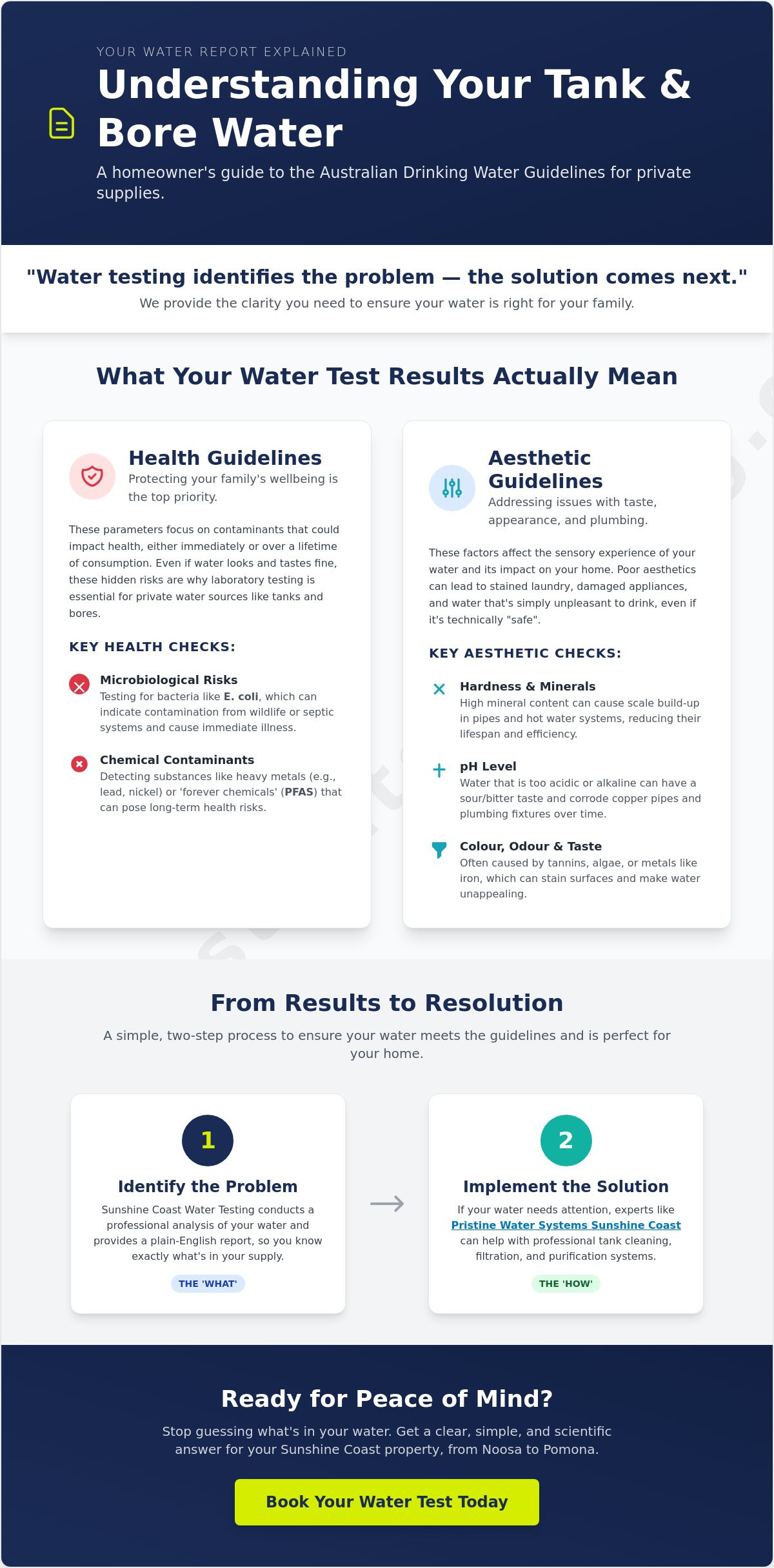
When you look at a water test report, the results are usually split into two categories: health and aesthetic. It's a common mistake to think that only the health section matters. Health-based guidelines focus on substances that could impact your family's wellbeing, either immediately or over many years of consumption. Aesthetic guidelines cover the sensory side of things, like taste, colour, and odour, as well as how the water interacts with your home's infrastructure. Within the context of the australian drinking water guidelines for private sources, potability is defined as water that is safe to drink over a lifetime and does not have offensive sensory qualities.
Even if your water is technically safe to drink, an aesthetic "fail" can be a major headache for a homeowner. For example, water with high mineral content might be safe for your health but could be slowly destroying your hot water system or staining your laundry. We always remind our clients from Noosa to Cooroy that water testing identifies the problem; the solution comes next.
Common Health Parameters in Private Supplies
Microbiological risks are the most frequent concern for private water users. Bacteria like E. coli or total coliforms can enter tanks via bird droppings or bores through soil runoff. A professional microbiological analysis is the only way to confirm your supply meets the grade. Chemical risks are also part of the health framework. The ADWG sets a strict limit of 0.01 mg/L for lead, which can sometimes leach from old plumbing. Recent updates in June 2025 also established new values for PFAS (forever chemicals), such as a limit of 8 nanograms per litre for PFOS. If your results show these levels are exceeded, your supply does not meet Australian Drinking Water Guidelines and should be addressed.
Aesthetic Factors: Taste, Odour, and Appearance
If your tea tastes metallic or your shower screen is covered in white crusty scales, you're dealing with aesthetic issues. The ADWG suggests a pH level between 6.5 and 8.5. If your bore water in Pomona or Doonan falls outside this range, it can be corrosive to copper pipes or cause "blue water" staining. High levels of iron and manganese are also common in Sunshine Coast bores, leading to a bitter taste and brown stains on tiles. While these aren't always a health risk, they certainly affect your quality of life. If you're concerned about the clarity or taste of your tap water, the first step is to book a standard drinking water test to see where you stand. Once Sunshine Coast Water Testing identifies exactly what's in your supply, Pristine Water Systems Sunshine Coast can provide targeted solutions like UV purification or specialized filtration to bring your water back to its best.
Private Water Sources: Your Responsibility for Tank and Bore Safety
If you live in a regional pocket like Cooroy or Tinbeerwah, you aren't just a resident; you're the manager of your own miniature water utility. The legal reality is that the responsibility for the quality of your supply stops with you. While the australian drinking water guidelines for private sources provide the necessary framework, the actual implementation of those standards is entirely in your hands. Relying on the idea that your water "looks okay" is a significant risk. Hidden contaminants like E. coli or dissolved heavy metals don't always change the colour or smell of the water, meaning a clear glass could still contain elements that don't meet national standards.
Local environmental factors play a massive role in your water's health. For properties around Doonan or Pomona, ash and sediment from past bushfires can settle in tanks, while agricultural runoff in farming areas can introduce nitrates or pesticides into groundwater. Regular testing isn't just about health; it's about protecting your home. High acidity or mineral imbalances can lead to long-term damage to your hot water systems, dishwashers, and taps. Identifying these issues early through a standard drinking water test saves you from expensive repairs down the track. We always advocate that water testing identifies the problem, and the solution comes next.
Rainwater Tank Maintenance Standards
The ADWG recommends regular inspections of your entire catchment area. Roof materials, lead flashing, and decaying organic matter in gutters can all degrade your supply over time. If your test results show the water does not meet Australian Drinking Water Guidelines and should be addressed, it often indicates a need for physical maintenance. Check out our rainwater tank testing guide for a step by step approach to keeping your system healthy. When issues are identified, Pristine Water Systems Sunshine Coast can provide professional tank cleaning and UV sterilisation to restore your supply.
Bore Water and Groundwater Compliance
Groundwater is often more chemically complex than rainwater. Bore water in the Sunshine Coast region can vary wildly in salinity and mineral content depending on the local geology. Because groundwater is filtered through soil and rock, it requires more frequent chemical screening to monitor for heavy metals or hardness. Testing before using bore water for domestic purposes is essential to ensure it won't corrode your pipes or affect your garden. Sunshine Coast Water Testing provides plain-English summaries that make these technical bore reports easy to understand for any homeowner. This clarity allows you to make informed decisions about your household's most vital resource.
Testing Your Private Supply Against National Standards
How do you actually check if your tank or bore water measures up to the national benchmark? Following the australian drinking water guidelines for private sources doesn't have to be a complicated process. It's about taking a structured approach to understand what is happening inside your pipes. By following a few simple steps, you can move from uncertainty to a clear plan of action.
- Step 1: Identify your primary concerns. Are you worried about a metallic taste in Noosa, or is it the long-term health of your family? Knowing your goals helps tailor the specific analysis you need.
- Step 2: Collect a proper sample. You must use a sterile, laboratory-grade container. Using a washed-out household jar can introduce outside bacteria, which completely ruins the accuracy of your results.
- Step 3: Organise a professional water analysis. This ensures your sample is handled by experts who know exactly how to measure against the ADWG.
- Step 4: Receive your Certificate of Analysis (COA). At Sunshine Coast Water Testing, we pair this technical data with a plain-English summary so you aren't left staring at a wall of numbers.
- Step 5: Review the recommendations. This final step tells you if your water meets the grade or if there are specific areas that require a fix.
Professional Lab Testing vs. DIY Kits
It's tempting to grab a cheap DIY test strip from the hardware store, but these often fail to detect critical health-based parameters. A strip might tell you the pH level, but it won't identify heavy metals like lead or emerging contaminants like PFAS. For accurate results, a NATA-accredited laboratory is essential. These labs use calibrated equipment to find even tiny amounts of contaminants that a colour-changing strip will miss. Sunshine Coast Water Testing bridges the gap between the lab and your kitchen table. We translate raw data into a helpful report that explains what the findings mean for your home in Pomona or Tinbeerwah.
How Often Should You Test?
Consistency is key to maintaining a healthy supply. We recommend an annual health check for all private sources to monitor microbiological safety. However, certain "trigger events" should prompt an immediate test. If you've experienced heavy rain, local flooding, or significant land use changes near your property, your water quality could shift overnight. Ensuring your standard water test covers the right bases gives you the peace of mind that your supply remains consistent.
Remember, water testing identifies the problem; the solution comes next. If your results show that your supply does not meet Australian Drinking Water Guidelines and should be addressed, Pristine Water Systems Sunshine Coast provides the filtration and purification systems needed to resolve the issue. If you are unsure where to start, the best first step is to book a water test and get the facts about your household supply.
From Results to Resolution: Managing Your Water Quality
Getting your lab results back is a big milestone. It's the moment you move from guessing to knowing exactly what's in your glass. However, a technical Certificate of Analysis can be intimidating if you aren't a scientist. This is where the value of an independent advisor comes in. Sunshine Coast Water Testing doesn't just hand over raw data; we provide a plain-English summary that interprets the australian drinking water guidelines for private sources for your specific situation. Because we are a dedicated testing service, we aren't here to push expensive hardware or unnecessary repairs. We simply give you the honest facts so you can decide what happens next.
If your report indicates that your water does not meet Australian Drinking Water Guidelines and should be addressed, don't panic. Many common issues, like slightly low pH or the presence of bacteria, have straightforward fixes. The goal of using the australian drinking water guidelines for private sources is to provide a safety benchmark, not to cause alarm. Once you have your summary, you can make a logical, informed choice about the right treatment for your home in Cooroy or Doonan. We always remind our clients that water testing identifies the problem; the solution comes next.
Fixing the Issue with Professional Solutions
Identifying the problem is the first half of the journey. The second half is implementing a solution that works. Whether your bore water has high iron levels or your rainwater tank has tested positive for coliforms, targeted action is the best way forward. For physical solutions like tank cleaning, filtration, or UV purification, we recommend Pristine Water Systems Sunshine Coast. They specialise in the practical side of water quality. By installing professional systems, you ensure your household supply remains compliant with national standards and is pleasant to use for years to come.
Maintaining a Safe Water Cycle
Water management isn't a "set and forget" task. Once you've installed a new filtration system or had your tank professionally cleaned, re-testing is a vital step. This confirms the fix has worked and that your water now meets the necessary benchmarks. We suggest creating a simple maintenance schedule to stay on top of things. This should include:
- Checking your gutters and roof catchment for debris every few months.
- Inspecting tank seals and mosquito mesh for any signs of damage.
- Booking an annual professional health check to monitor microbiological safety.
- Re-testing after significant weather events like floods or heavy storms.
This proactive approach ensures long-term peace of mind for your family. From the hills of Pomona to the coast of Noosa, keeping your water at its best is a steady, manageable process. When you combine accurate testing with professional solutions, you take the guesswork out of household safety.
Securing Your Family's Water Quality
Managing your own water supply doesn't have to be a guessing game. By now, you should have a clearer picture of how the australian drinking water guidelines for private sources help you maintain a healthy household. You are the manager of your property's water, but you don't have to navigate the technical details alone. We've seen that water testing identifies the problem; the solution comes next. Whether you're dealing with mineral build-up in your pipes or want to verify microbiological safety, professional data is your best tool for long-term protection.
Sunshine Coast Water Testing provides the clarity you need through NATA-accredited laboratory analysis paired with plain-English summaries. This ensures you aren't just looking at a wall of numbers; you're understanding exactly what they mean for your home and appliances. If your results suggest a fix is needed, our trusted local experts can guide you toward the right resolution. Take the first step toward total peace of mind for your family and your infrastructure. Book your professional water test today to ensure your supply meets the guidelines. It's the simplest way to ensure your tank or bore water remains a reliable resource for years to come.
Frequently Asked Questions
Who is responsible for the quality of my private water supply?
You are the sole water authority for your own property. Unlike town supplies managed by local councils, the responsibility for monitoring and maintaining a private source rests entirely with the homeowner. This means you must ensure your supply aligns with the australian drinking water guidelines for private sources to protect your household's wellbeing and your plumbing infrastructure. Regular testing is the only way to confirm your supply meets the grade.
Is rainwater in Australia safe to drink without testing?
You cannot assume rainwater is safe to drink without professional analysis. Environmental factors like bird droppings, decaying roof debris, or industrial runoff can quickly alter the quality of your tank water. While rainwater is a fantastic resource, it can contain bacteria or chemicals that don't meet national standards. A Rainwater Tank Health Check is the best way to confirm that your stored water is suitable for your family.
How do the 2025/2026 PFAS updates affect my private bore water?
Recent June 2025 updates established stricter values for PFAS chemicals, which are a growing concern for bore water users. These "forever chemicals" don't break down naturally in the environment. If your bore water analysis shows levels exceeding 8 nanograms per litre for PFOS, your supply does not meet Australian Drinking Water Guidelines and should be addressed. We provide plain-English summaries to help you understand how these updated australian drinking water guidelines for private sources impact your specific results.
What should I do if my water does not meet Australian Drinking Water Guidelines?
If your results indicate an issue, the first step is to review your plain-English summary to identify the specific problem. There is no need to panic; most issues have practical, straightforward solutions. Sunshine Coast Water Testing identifies the problem, and then Pristine Water Systems Sunshine Coast provides the fix through targeted filtration, UV purification, or professional tank cleaning to bring your water back to standard.
Can I use the ADWG to check if my bore water is suitable for irrigation?
The ADWG is specifically designed for drinking water, but the data from a professional analysis is incredibly useful for irrigation too. High salinity or mineral imbalances can damage sensitive plants and stain garden paths or fences. By testing your supply, you gain a clear understanding of the water's chemical profile. This helps you manage your garden's health and prevent soil degradation or damage to your irrigation pumps.
What is the difference between a health-based and an aesthetic guideline?
Health-based guidelines focus on substances like bacteria or heavy metals that could impact your family's wellbeing over a lifetime of consumption. Aesthetic guidelines deal with things like turbidity, pH, and mineral content that affect the taste, colour, and odour of your water. While aesthetic issues might not be an immediate health risk, they can cause significant damage to your hot water systems and household appliances if left unmanaged.
How often should I have my rainwater tank professionally tested?
We recommend a professional health check for your rainwater tank at least once a year. This annual routine ensures that your microbiological safety remains high throughout the seasons. You should also consider testing after significant "trigger events" like heavy storms, local floods, or nearby land clearing. Regular monitoring helps you catch small issues before they become expensive problems for your home's pipes and filtration systems.
Does boiling water make it meet the Australian Drinking Water Guidelines?
Boiling water is effective for neutralising microbiological risks like E. coli, but it does not remove chemical contaminants or heavy metals. In fact, boiling can sometimes concentrate minerals like lead or nitrates as the water evaporates. If your water contains chemical elements that do not meet Australian Drinking Water Guidelines and should be addressed, boiling is not a complete solution. Professional filtration is required to remove these substances effectively.

Article by
Stephen McDougall
Stephen McDougall is the owner of Pristine Water Systems Sunshine Coast and Sunshine Coast Water Testing, specialising in water quality, filtration, and tank systems. He is known for delivering clear, easy-to-understand advice and practical solutions to help clients maintain safe, reliable water.
Disclaimer
The information provided in this article is for general guidance only and is not a substitute for professional water testing or site-specific advice. Water quality can vary between properties. For accurate results and recommendations, we recommend professional testing and assessment.