Nitrate in Drinking Water: An Essential Guide for Australian Property Owners
If your bore water looks crystal clear and tastes perfectly fresh, could it still pose a hidden risk to your family's health? It's a confronting thought for many Sunshine Coast property owners who rely on private supplies. Whether you are concerned about agricultural runoff or simply trying to decode a lab report that lists nitrate nitrate levels, the technical jargon can be overwhelming. It's completely understandable to feel uncertain about whether your water meets the Australian Drinking Water Guidelines, especially when terms like "Blue Baby Syndrome" are mentioned in the same breath as your backyard bore.
We agree that water chemistry shouldn't feel like a confusing science project. You deserve to know exactly what is in your glass without the corporate double-talk. This guide will help you learn the critical differences between nitrate and nitrite, the genuine health risks involved, and how to accurately test your water supply. We'll provide a clear breakdown of the 50 mg/L health limit for infants and explain why professional laboratory analysis is more reliable than a $14.95 aquarium kit. By the end, you'll have a practical plan to ensure your drinking water is safe for everyone in your home.
Key Takeaways
- Understand why the Australian Drinking Water Guidelines set a strict 50 mg/L limit for infants to prevent health risks like "Blue Baby Syndrome".
- Identify how agricultural fertilisers and intensive livestock farming can cause sudden nitrate nitrate spikes in your local bore water or groundwater supply.
- Learn the critical differences between nitrate and nitrite and why even low levels of nitrite require immediate attention in your household.
- Discover why professional NATA-accredited laboratory analysis is essential for accuracy, as many DIY kits have a margin of error too high for drinking water safety.
- Follow a practical, step-by-step process for collecting sterile water samples to ensure your results are reliable and easy to interpret.
Understanding Nitrate and Nitrite in Your Water Supply
Is your groundwater as safe as it looks? Nitrate is a form of nitrogen that occurs naturally in our environment. In small amounts, it's a vital nutrient for plants. However, when concentrations spike, it transforms from a helpful fertiliser into a serious health concern for rural households. To answer the fundamental question, What is nitrate?, it is essentially a compound of nitrogen and oxygen that moves easily through Australian soil and into our aquifers.
Across the Sunshine Coast and regional Australia, the nitrogen cycle is constantly at work. Organic matter like leaf litter or animal waste breaks down, releasing nitrogen into the soil. Bacteria then convert this into nitrate, which plants soak up to grow. The problem arises when there's an excess of nitrogen, often from fertilisers or septic systems, which the plants can't use. Rainwater then washes this surplus deep into the ground, leading to elevated nitrate nitrate levels in the bore water we rely on for drinking.
The Chemical Difference: Nitrate vs. Nitrite
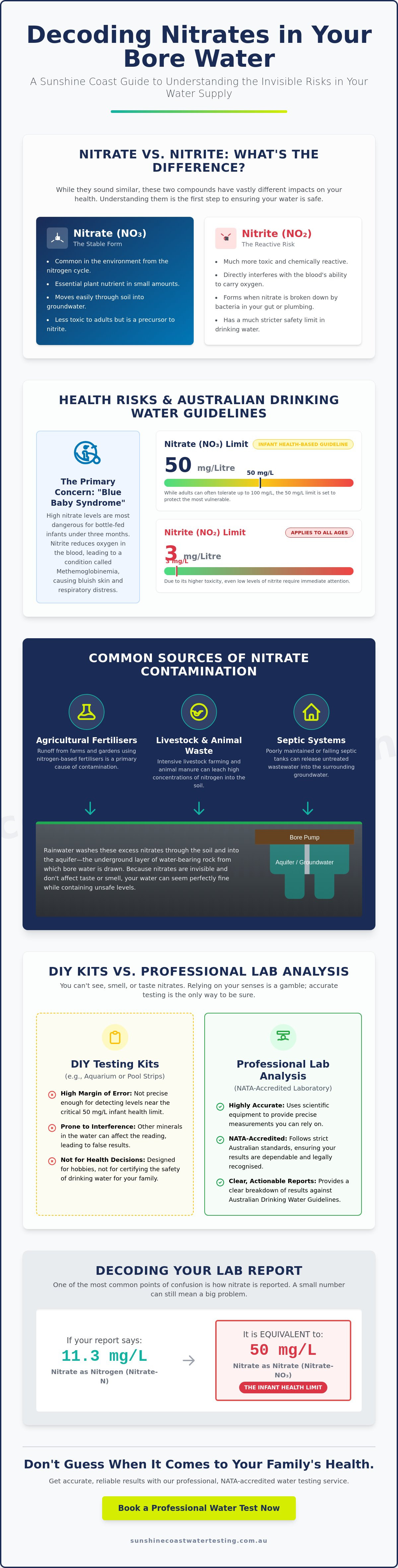
Nitrate (NO3) is the more stable form, but it has a more reactive cousin called nitrite (NO2). While nitrate itself isn't highly toxic to adults, it can convert into nitrite within your body's digestive system or even inside your plumbing. Nitrite is far more aggressive. It interferes with how your blood carries oxygen, which is why the Australian Drinking Water Guidelines set the nitrite limit at a tiny 3 mg/L, compared to the 50 mg/L health limit for nitrate.
When you receive a lab report from a facility in Noosaville or elsewhere in Australia, you might see two different reporting styles. "Nitrate as N" measures only the nitrogen part of the molecule, while "Nitrate as NO3" measures the whole compound. This technical distinction often leads to confusion. For instance, 11.3 mg/L of Nitrate-N is actually equivalent to the 50 mg/L health limit for Nitrate-NO3. We ensure our reports provide clear results that actually make sense, so you aren't left guessing which standard applies to your home.
Why Visual Checks Are Never Enough
You can't see, smell, or taste these compounds. Unlike iron, which leaves orange stains, or tannins that turn water tea-coloured, nitrates are completely invisible. Your water could look like it came straight from a mountain spring while actually containing double the safe limit for a bottle-fed infant. The 2022-2023 reports from remote Western Australian communities showed that while water looked fine, 22 communities still exceeded the 50 mg/L infant safety guideline.
This "silent" nature is why many properties across regional Australia fail health standards without the owners ever knowing. Relying on your senses to judge water quality is a gamble you don't need to take. To get a definitive answer, you need a professional water analysis that uses precise equipment to detect what the naked eye cannot. We focus on providing practical advice only, helping you understand if those invisible numbers on a page mean your water is safe or if it's time to take action.
The Health Risks of Elevated Nitrate Levels
Why does a specific number on a lab report matter so much? The primary health concern with high nitrate levels is a condition called methemoglobinemia, commonly known as "Blue Baby Syndrome". When infants ingest too much nitrate, their digestive systems convert it into nitrite. This nitrite then binds to haemoglobin in the blood, preventing it from carrying oxygen to vital organs. For a small child, this can lead to a bluish skin tint and, in severe cases, serious respiratory distress. The Australian Drinking Water Guidelines establish a health-based limit of 50 mg/L specifically to protect bottle-fed infants under three months of age.
While infants are the most sensitive, they aren't the only ones who should be cautious. Pregnant women and individuals with specific rare enzyme deficiencies, such as G6PD deficiency, may also be more susceptible to oxygen transport issues. However, for most healthy adults and older children, the risk is significantly lower. The human body is generally resilient. Adults can often tolerate water with levels up to 100 mg/L without immediate health effects, though it's certainly not a recommended long-term habit. If you're unsure about your current supply, you can book a water test to confirm your levels are within the safe range.
Protecting the Most Vulnerable: Infants and Pregnancy
Babies under six months are at the highest risk because their stomach acid is less developed. This lower acidity allows nitrate-converting bacteria to thrive, which speeds up the production of toxic nitrite. If you've just moved into a new property on the Sunshine Coast that relies on an old bore, testing is your first priority. If your results show high nitrate nitrate concentrations, you must use an alternative water source, such as rainwater or bottled water, for mixing infant formula. It's a simple step that provides immediate peace of mind for growing families.
Long-term Exposure and Chronic Health Concerns
What about the rest of the household? Emerging research is looking at potential links between chronic nitrate ingestion and long-term health issues, but the data isn't yet conclusive. Taking a "safety first" approach means keeping your levels below the 50 mg/L mark regardless of age. One common mistake is trying to boil the problem away. Unlike bacteria, nitrates don't "die" when heated. Boiling actually makes the water more dangerous; as the steam escapes, the nitrate remains behind, making the final glass of water more concentrated than when you started.
Common Sources of Nitrate Contamination in Australia
Where exactly does this contamination begin? While nitrogen is a natural part of the environment, human activity is the primary driver behind dangerous nitrate nitrate spikes in Australian water supplies. Nitrogen-based fertilisers used in large-scale agriculture are the leading culprits. When farmers apply more fertiliser than crops can absorb, the excess sits in the soil, waiting for the next heavy downpour to wash it into the nearest creek or aquifer.
Intensive livestock farming also plays a major role. Dairies, piggeries, and feedlots produce high volumes of animal waste in concentrated areas. This waste is rich in ammonia, which soil bacteria quickly convert into nitrate. Without proper management, this effluent can seep through the earth and pollute groundwater for kilometres. Similarly, a poorly maintained septic system on your own property can be a source of trouble. If a septic tank leaks or the leach field is positioned too close to a bore, nitrogen-rich wastewater can bypass the soil's natural filtration and enter your drinking supply directly.
Bore Water and Groundwater Vulnerability
Your bore's depth is often the deciding factor in its safety. Shallow, unconfined aquifers are the most vulnerable because they have less soil to act as a filter between the surface and the water table. In some rural Australian regions, groundwater nitrate concentrations have been recorded as high as 1300 mg/L, far exceeding any safe drinking standard. This is why WA Department of Health advice on nitrate emphasises the risk for those in arid or agricultural zones. If you live in a farming area, regular bore water analysis is the only way to ensure your supply hasn't been compromised by seasonal runoff.
Rainwater Tanks and Organic Debris
Many people assume rainwater is immune to chemical issues, but your tank's ecosystem can create its own nitrogen problems. Bird droppings, leaf litter, and dust accumulate on your roof and eventually wash into the tank. As this organic matter decays in the sludge at the bottom, it releases ammonia. Over time, specialised bacteria in the tank convert this ammonia into nitrate. This biological process means your tank water quality can change even without external pollution. To keep your system healthy, combining chemical testing with a microbiological analysis ensures you are catching both the chemical and bacterial risks that thrive in organic sediment.
How to Test for Nitrates and Interpret Your Results
How do you actually find out if your water is safe? Since you cannot see, smell, or taste these compounds, laboratory testing is the only way to get a definitive answer. Most Sunshine Coast property owners start the process when they notice a change in their environment or simply want peace of mind for a new baby. The process is straightforward, but it requires scientific precision to ensure the results are reliable.
To collect a sample that provides an accurate reading of your nitrate nitrate levels, follow these steps. First, use a sterile bottle provided by your testing facility. Second, run your tap or bore pump for at least two to three minutes to flush out any stagnant water sitting in the pipes. Third, fill the bottle to the top to minimise the amount of air inside, then seal it tightly. Finally, keep the sample cool and deliver it to the lab as soon as possible. Professional laboratory equipment is essential because it can detect concentrations as low as 0.01 mg/L, providing a level of detail that home kits simply cannot match.
You should consider testing your water supply during these specific times:
- Immediately after the first heavy rain event following a dry spell.
- If there has been new construction or significant earthworks on a neighbouring property.
- Annually, as part of a standard health check for independent water supplies.
- Whenever a new infant or pregnant woman joins the household.
Reading Your Laboratory Report
The Australian Drinking Water Guidelines (ADWG) limit is the gold standard for Australian water safety. When you open your report, look closely at how the results are expressed. Some labs report "Nitrate-N" (Nitrate as Nitrogen), while others report "Total Nitrate" (NO3). If your report lists Nitrate-N, you must multiply that figure by 4.427 to see how it compares to the 50 mg/L health limit. If your report shows a result as "non-detect" or "below LOR" (Limit of Reporting), it means the levels are so low that the equipment could not find them. This is the ideal outcome for your household health.
When to Organise a Retest
Water quality is not a "set and forget" metric. Nitrates often spike after the first big rains of the season when fertilisers and organic waste are washed into the groundwater at once. A single "pass" during the dry season does not guarantee the water will remain safe throughout the year. If your property relies solely on a private bore or rainwater tank, a regular testing schedule is the only way to ensure your water remains compliant with national standards. If you are ready to check your current supply, you can book a water test today to get clear, practical results.
Professional Laboratory Analysis vs. DIY Testing Kits
Is a fifteen-dollar test kit really enough to protect your family's health? While hardware store strips and aquarium kits are tempting for a quick check, they often lack the precision required for human consumption standards. When you are monitoring your nitrate nitrate concentrations, the margin of error in a cheap kit can be the difference between a "safe" reading and a genuine health risk. Most DIY kits, like the Aqua One Nitrate Test Kit which costs around $14.95, are designed for fish tanks where the stakes are lower and the chemistry is less complex than a deep-water bore.
Professional laboratory analysis uses NATA-accredited methods to provide a level of accuracy that home kits simply cannot match. While a "Chemical Analysis" at a professional lab might cost upwards of $54.50, you are paying for scientific certainty. Experts use calibrated equipment in controlled environments to ensure that temperature, lighting, and shelf-life do not skew your results. Nitrate is often a "gateway" contaminant. If agricultural runoff or septic effluent is reaching your water supply, it's likely that other invisible threats are present too. This is why we often recommend a comprehensive heavy metals testing alongside your nitrate analysis to ensure total household safety.
The Limitations of Home Test Strips
DIY strips rely on a colour change that you have to judge with your own eyes. Have you ever tried to match a wet piece of paper to a tiny colour chart under a flickering kitchen light? It's notoriously difficult. This subjectivity leads to "false negatives," where you might believe your water is safe when it's actually over the 50 mg/L limit. These strips also have a limited shelf-life; once opened, exposure to humidity can ruin the reagents. Professional labs eliminate this guesswork by using spectrophotometry to measure light absorption at specific wavelengths, providing a concrete number rather than a "best guess" shade of pink.
Getting Clear Results with Sunshine Coast Water Testing
We believe in providing "More Than Just Numbers on a Page." Our mission is to take complex chemistry and turn it into information you can actually use. Our reports follow our local signature: Local Testing. Clear Results. Practical Advice. Instead of leaving you to wonder what a high nitrate reading means for your morning coffee or your baby's formula, we provide a transparent breakdown of what to do next. We are your knowledgeable neighbours in Noosaville, committed to ensuring your water meets Australian standards without the corporate jargon or high-pressure sales tactics. Book your standard drinking water test today for total peace of mind and results that finally make sense.
Secure Your Family's Water Quality Today
Managing your property's water supply shouldn't be a guessing game. You now understand that while nitrate nitrate levels are invisible and tasteless, their impact on household safety is very real. Protecting the most vulnerable members of your family starts with moving beyond visual checks and relying on certified scientific data. By choosing professional analysis, you're opting for the 50 mg/L health-based certainty defined by the Australian Drinking Water Guidelines rather than the unreliable results of a home test strip.
At Sunshine Coast Water Testing, we provide NATA-accredited laboratory analysis and reports that actually make sense. We believe in providing more than just numbers on a page; we offer the no-nonsense practical advice you need to keep your home safe. Whether you're in Noosaville or the wider hinterland, our local expertise ensures you get clear answers without the corporate jargon. Ensure your water is safe—book your professional lab test now for total peace of mind. Taking this simple step today ensures your drinking water remains a source of health for years to come.
Frequently Asked Questions
Is nitrate in drinking water dangerous for adults?
Healthy adults can typically tolerate nitrate levels up to 100 mg/L without immediate health issues. The primary risk is for infants under three months old, whose digestive systems are far more sensitive. However, some adults with specific health conditions or rare enzyme deficiencies may be more susceptible to oxygen transport issues. While it isn't an immediate threat to most, keeping your supply below the 50 mg/L guideline is the safest long-term approach for everyone in your household.
Can I boil my water to remove nitrates?
No, boiling water won't remove nitrates; it actually increases their concentration. As water evaporates into steam, the nitrates remain in the pot, leaving the remaining liquid more concentrated than when you started. To reduce nitrate levels, you need specific treatment systems like reverse osmosis or ion exchange. If your test results show high levels, switching to an alternative source like bottled water is a better immediate solution than reaching for the kettle.
What is the Australian limit for nitrates in drinking water?
The Australian Drinking Water Guidelines set a health-based limit of 50 mg/L to protect infants under three months of age. For adults and children over three months, the limit is 100 mg/L. These standards ensure that your water is safe for the most vulnerable members of the community. Monitoring your supply ensures you stay within these national safety margins, especially if you rely on a private bore for your daily drinking water.
How do nitrates get into my rainwater tank?
Nitrates enter rainwater tanks primarily through the decay of organic matter like bird droppings and leaf litter. When these materials break down in the sediment at the bottom of your tank, bacteria convert the resulting ammonia into nitrate. This biological process can cause nitrate nitrate levels to rise over time even if the rain itself is clean. Regular tank maintenance and gutter cleaning are essential to prevent this organic buildup from compromising your supply.
What are the symptoms of high nitrate levels in infants?
The most recognisable symptom is a bluish or greyish tint to the skin, particularly around the mouth, hands, and feet. This condition, known as "Blue Baby Syndrome," occurs because the infant's blood cannot carry enough oxygen to vital organs. Other signs include irritability, lethargy, and shortness of breath. If you notice these symptoms in a bottle-fed infant, seek medical attention immediately and stop using your current water supply for formula preparation.
How often should I test my bore water for nitrates?
You should test your bore water at least once every twelve months to monitor for seasonal changes. It is also wise to organise a retest after significant weather events, such as the first heavy rains following a long dry spell. These rains can flush fertilisers and animal waste into the groundwater table quite rapidly. Regular testing provides a historical record of your water quality, making it easier to spot emerging contamination trends on your property.
Does a standard water filter remove nitrates?
Standard carbon or sediment filters found in most kitchen jugs and under-sink systems do not remove nitrates. These filters are designed to improve taste and remove chlorine or large particles, but nitrate molecules are too small for them to catch. To effectively lower nitrate concentrations, you generally require a reverse osmosis system or a specialised ion-exchange resin. Always check the manufacturer's specifications to confirm if a filter is specifically rated for nitrate removal.
What is the difference between Nitrate-N and Nitrate on my report?
Nitrate-N measures only the nitrogen part of the molecule, while "Nitrate" (as NO3) measures the entire compound. This distinction is important because the 50 mg/L Australian health limit refers to Total Nitrate. To convert a Nitrate-N result to Total Nitrate, you must multiply it by 4.427. Our reports include clear explanations of these figures so you don't have to perform complex calculations to understand your own household water safety.

Article by
Stephen McDougall
Stephen McDougall is the owner of Pristine Water Systems Sunshine Coast and Sunshine Coast Water Testing, specialising in water quality, filtration, and tank systems. He is known for delivering clear, easy-to-understand advice and practical solutions to help clients maintain safe, reliable water.
Disclaimer
The information provided in this article is for general guidance only and is not a substitute for professional water testing or site-specific advice. Water quality can vary between properties. For accurate results and recommendations, we recommend professional testing and assessment.