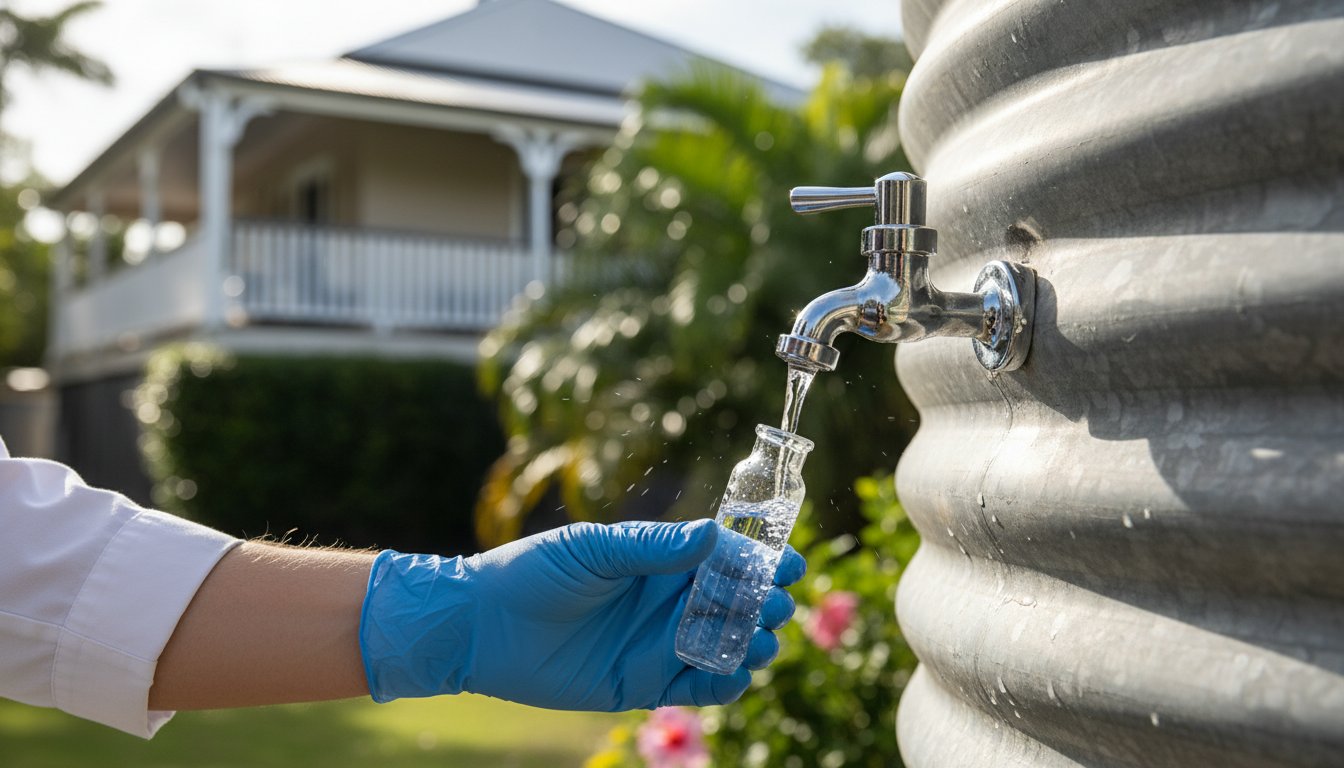
PFAS Testing in Private Water Sources Australia: A Homeowner’s Guide
Did you know that as of July 2025, the Australian government officially banned the import and use of several major "forever chemicals"? For homeowners in spots like Cooroy, Doonan, or Tinbeerwah, this regulatory shift highlights the growing importance of PFAS testing in private water sources australia. If you rely on a bore or rainwater tank, it's natural to feel a bit uneasy about what's actually in your supply, especially with over 315 locations nationwide now confirming contamination issues in various water systems.
We understand that technical terms like PFOS and PFOA are confusing, and generic DIY kits often fail to provide the certainty you deserve. You want clear answers about whether your water meets the updated 2025 NHMRC health guidelines, which set strict new limits like 8 nanograms per litre for PFOS. This guide promises to demystify these chemicals and show you how to professionalise your testing approach in 2026. We'll explain the real-life impacts on your household and how Sunshine Coast Water Testing provides the plain-English clarity needed to move forward. Remember, water testing identifies the problem; a professional solution from Pristine Water Systems Sunshine Coast is how you fix it.
Key Takeaways
- Understand why PFAS are called "forever chemicals" and how their persistence in the environment impacts local water supplies.
- Discover how groundwater plumes move and why professional PFAS testing in private water sources australia is the only way to get a clear picture of your supply.
- Learn about the updated 2026 Australian Drinking Water Guidelines and the new health-based thresholds for chemicals like PFOS and PFOA.
- Master the specific "PFAS-free" sampling protocols required to ensure your water samples aren't accidentally contaminated during collection.
- Find out how to move from identifying a problem to implementing a solution with plain-English result summaries and practical next steps.
What are PFAS and Why Are They Called "Forever Chemicals"?
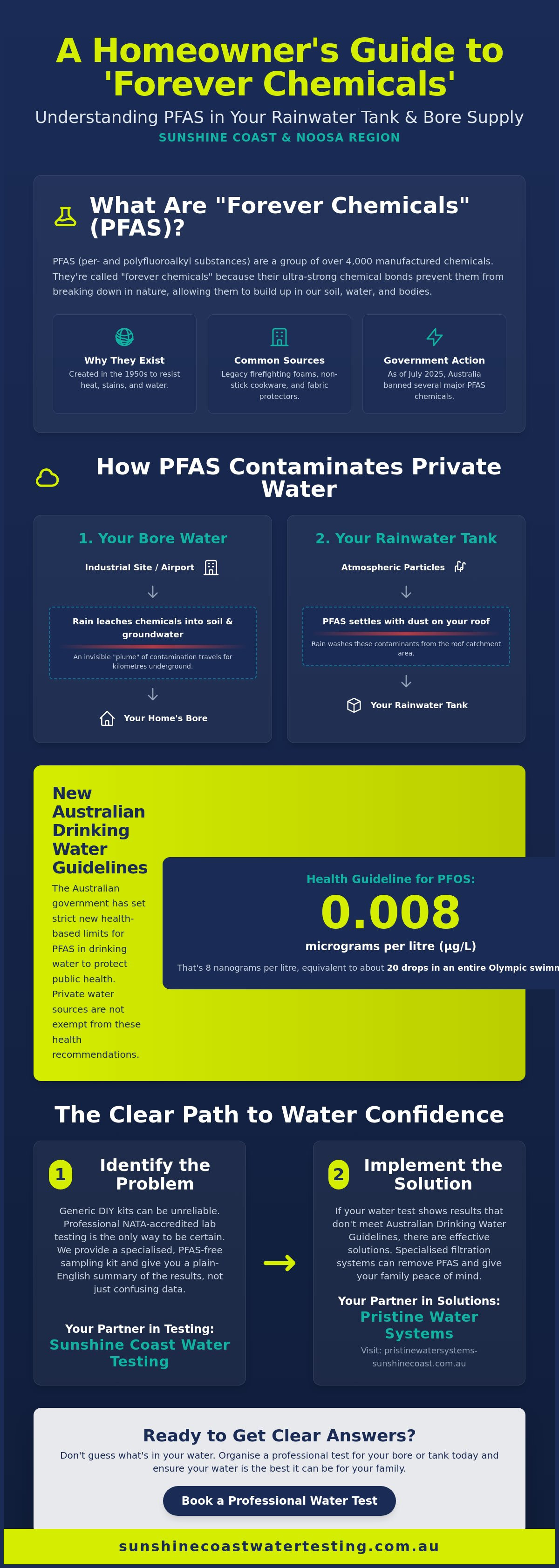
PFAS is a shorthand name for a massive group of more than 4,000 manufactured chemicals known as per- and polyfluoroalkyl substances. These compounds have been in use globally since the 1950s because of their incredible ability to resist heat, stains, and water. You've likely encountered them in your own home in non-stick frypans or treated carpets. To understand the science behind these substances, it helps to look at What are PFAS "forever chemicals"? and how their unique structure makes them so persistent.
They earned the "forever chemicals" nickname because they simply do not break down naturally in the environment. The chemical bond between carbon and fluorine is one of the strongest in existence, meaning once these substances enter our soil or water, they stay there for decades. Because they are water-soluble, they travel easily through the environment. Over time, they can accumulate in the human body, which is why PFAS testing in private water sources australia has become a priority for families relying on independent supplies rather than treated town water.
Common Uses of PFAS in Australia
In Australia, the most significant source of environmental contamination has historically been legacy firefighting foams. These were used extensively for decades at airports, RAAF bases, and industrial fire training sites. When these foams were sprayed during drills or emergencies, the chemicals soaked into the ground and eventually reached the water table. Beyond these industrial sites, PFAS were common in domestic products like Scotchguard fabric protectors and various water-repellent coatings. While the Australian government banned the import and use of PFOS, PFOA, and PFHxS in July 2025, the "forever" nature of these chemicals means they remain a concern for local groundwater systems today.
Why Private Water Sources Are Vulnerable
If you live in areas like Noosa, Doonan, or Pomona, your water security often depends on a private bore or a rainwater tank. These sources are particularly vulnerable to PFAS because they lack the large-scale filtration systems used by municipal utilities. Bore water is at risk because "plumes" of contaminated groundwater can travel kilometres away from an original site, like a regional airport or industrial centre. Rainwater tanks aren't immune either; they can collect PFAS that has attached to dust or moved through the atmosphere before settling on your roof.
Homeowners are responsible for managing their own water quality. At Sunshine Coast Water Testing, we specialise in providing a Standard Drinking Water Test that helps you understand exactly what's in your supply. We provide plain-English summaries so you aren't left staring at a confusing list of numbers. Always remember: water testing identifies the problem; the solution comes next. If your results show that your supply does not meet Australian Drinking Water Guidelines, a professional system from Pristine Water Systems Sunshine Coast can help address the issue through targeted filtration or purification.
How PFAS Contamination Reaches Private Bores and Rainwater Tanks
If you've ever looked at a glass of crystal-clear bore water and assumed it was perfect, you aren't alone. Many homeowners in areas like Cooroy and Doonan rely on the visual clarity of their water as a sign of quality. However, "forever chemicals" move through the environment in ways that the naked eye simply cannot detect. The primary pathway into your supply is a process called leaching. Because PFAS are highly water-soluble, they don't stick to soil. Instead, rain washes them down through the earth and into the groundwater table.
Once these chemicals reach the groundwater, they form what scientists call "plumes." These plumes act like invisible underground rivers of contamination that can travel for kilometres, following the natural movement of the aquifer. This is why PFAS testing in private water sources australia is so critical. Even if the original source of the chemical was a distant industrial site or a legacy firefighting training ground, the moving groundwater can eventually bring those substances directly to your backyard bore.
Rainwater tanks face a different set of risks. While we often think of rain as pure, it can collect atmospheric PFAS as it falls. These chemicals can also attach to dust particles from nearby industrial areas or roads, settling on your roof. When the next downpour hits, those particles are washed straight into your tank. Without professional analysis, there's no way to know if your tank water meets the Australian Drinking Water Guidelines.
Proximity Risks for Homeowners
Living near an airport, a fire station, or a major industrial centre significantly increases the likelihood of finding these chemicals in your water. Historic land use plays a massive role here. Even if a site hasn't used firefighting foam in years, the chemicals remain in the soil and water table. We often see cases where one property has high levels while a neighbour's bore is relatively clear, simply because of how the underground plume is shaped. This unpredictability makes individual testing vital for your peace of mind.
The Problem with "Invisible" Contaminants
You cannot see, taste, or smell PFAS. Unlike iron which stains your laundry or sulphur which smells like eggs, these chemicals are completely stealthy. Most standard water tests focus on common issues like pH, bacteria, or hardness and will miss PFAS entirely. Detecting these substances requires targeted lab analysis that looks for concentrations at the nanogram level. That is the equivalent of a single postage stamp on a football field.
At Sunshine Coast Water Testing, we believe that water testing identifies the problem, while the solution comes next. If your results show levels that should be addressed, we can point you toward effective treatment options. For example, Pristine Water Systems Sunshine Coast provides specialised filtration and tank cleaning services designed to manage these specific contaminants. If you're concerned about your local groundwater, the best first step is to book a professional water assessment to get the facts about your supply.
Understanding the 2026 Australian Drinking Water Guidelines for PFAS
The standards for what we consider acceptable in our water supplies changed significantly following a major review by the National Health and Medical Research Council (NHMRC) on June 25, 2025. This update reflects the most current scientific understanding of "forever chemicals" and has set much stricter benchmarks for 2026. For homeowners, PFAS testing in private water sources australia is now measured against these refined health-based guideline values. These guidelines act as a preventative framework, designed to protect your health over a lifetime of exposure.
The current Australian Drinking Water Guidelines (ADWG) specify the following limits:
- PFOS: 8 nanograms per litre
- PFOA: 200 nanograms per litre
- PFHxS: 30 nanograms per litre
- PFBS: 1000 nanograms per litre
If a lab report shows concentrations above these levels, the water does not meet Australian Drinking Water Guidelines and should be addressed. It's important to remember that these values aren't about immediate illness. Instead, they are set conservatively to ensure that even after decades of daily use, the risk remains as low as possible. Understanding these numbers is the first step toward managing your household water health effectively.
Interpreting the Numbers: What is a Nanogram?
Visualising a nanogram per litre can be tricky because the scale is so incredibly small. One nanogram per litre is equivalent to one part per trillion. To put that in perspective, it's like a single drop of water in an Olympic-sized swimming pool. This level of precision is why modern heavy metals testing and PFAS analysis require highly sensitive laboratory equipment. You simply can't find these minute concentrations with a basic home kit; only targeted lab analysis can provide the accuracy needed to match the 2026 standards.
Health and Household Impact
Managing long-term exposure is a priority for families in regional areas like Pomona or Tinbeerwah. When you use bore water for more than just drinking, such as watering a vegetable garden or providing for livestock, these chemicals can potentially find their way into your food chain. Knowing your levels are within ADWG limits provides genuine peace of mind for the whole family.
At Sunshine Coast Water Testing, we don't just hand over a page of raw data. We provide a plain-English summary that explains exactly how your supply compares to the national guidelines. We believe that water testing identifies the problem, while the solution comes next. If your water does not meet the guidelines, a professional filtration setup from Pristine Water Systems Sunshine Coast can help bring your supply back into alignment with the 2026 standards.
How to Organise PFAS Testing for Your Private Water Supply
Getting started with PFAS testing in private water sources australia is a straightforward process when you have the right local partner. Because these chemicals are measured in such tiny amounts, the process is more detailed than a standard check for pH or hardness. We follow a logical path to ensure your results are accurate and actionable, starting from the moment you reach out to us.
- Step 1: Contact Sunshine Coast Water Testing to request a specialised sampling kit. We provide the specific containers required for these unique chemicals.
- Step 2: Collect your water samples using "PFAS-free" protocols. This ensures that everyday items don't accidentally contaminate your sample.
- Step 3: Submit your samples to the laboratory. They use high-resolution mass spectrometry to detect chemicals at the nanogram level.
- Step 4: Receive your report. We don't just send raw data; we provide a plain-English summary that explains exactly how your water compares to the national guidelines.
Ready to get started? You can book your PFAS water test today to begin the process.
Why Professional Labs Beat Home Kits
You might see DIY strips at the hardware store, but these are generally designed for basic chemistry like swimming pool balance. They simply aren't sensitive enough to detect complex organic chemicals like PFAS. To know if your water meets the 2026 Australian Drinking Water Guidelines, you need the precision of a professional laboratory. Furthermore, a formal Certificate of Analysis (COA) is a valuable document to keep with your property records, especially in areas like Noosa or Cooroy where water quality is a common topic for residents.
Sampling Best Practices
The most critical part of the process happens at your tap or bore head. Because PFAS are used in so many consumer goods, it's easy to accidentally taint a sample. We recommend avoiding waterproof clothing, such as Gore-Tex, or certain brands of sunscreen and moisturiser on the day you collect your water. These products can contain the very chemicals we're looking for, leading to a false reading.
We also look at "first draw" samples versus "flushed" samples. A first draw sample captures water that has been sitting in your pipes or pump overnight, while a flushed sample represents the water coming directly from your tank or aquifer. Testing both gives a complete picture of what your family actually drinks. Remember, water testing identifies the problem, while the solution comes next. If your results indicate that your supply needs attention, Pristine Water Systems Sunshine Coast offers the specialised filtration and tank cleaning services required to address the issue.
Interpreting Your Results and Finding a Path Forward
Receiving a laboratory report can be an overwhelming experience for any homeowner. While the data is precise, a page full of chemical acronyms and nanogram measurements doesn't immediately tell you what you need to know. At Sunshine Coast Water Testing, we believe that data without clarity isn't helpful. This is why we provide a plain-English summary with every report. We translate those complex laboratory figures into a clear comparison against the 2026 National Health and Medical Research Council guidelines. Our goal is to give you a transparent look at your water health without the scientific jargon.
It is vital to remember our core philosophy: water testing identifies the problem, while the solution comes next. If your PFAS testing in private water sources australia shows that your supply does not meet Australian Drinking Water Guidelines, it simply means action should be taken to address the levels. You aren't alone in this process. We help you understand the results so you can make an informed decision about the best way to manage your household water supply in areas like Noosa, Cooroy, or Pomona.
Fixing the Issue with Professional Solutions
If your results indicate that your water does not meet the guidelines, specialised filtration is the most effective path forward. Standard sediment filters aren't enough to catch "forever chemicals" because of their molecular size and water-solubility. Instead, systems utilising high-quality Granular Activated Carbon (GAC) or Reverse Osmosis (RO) are required to effectively remove these substances.
To implement these solutions, Pristine Water Systems Sunshine Coast can provide the necessary filtration hardware and expert installation tailored to your specific results. Whether it's a whole-house system or a targeted under-sink unit, they specialise in fixing the issues our testing identifies. Once installed, regular maintenance ensures these systems continue to perform at their peak, giving your family consistent access to water that aligns with national standards.
Next Steps for Your Household
For a truly comprehensive view of your water health, many homeowners choose to combine their PFAS analysis with testing for agricultural runoff. This is particularly relevant in regional spots like Doonan or Tinbeerwah where historic land use might have left a variety of traces in the groundwater. Having a full chemical profile allows for a much more targeted approach to filtration.
Once you have installed a new treatment system, we recommend organising a follow-up test. This verifies that the equipment is successfully reducing contaminants to levels within the Australian Drinking Water Guidelines. Taking these steps moves you from uncertainty to total confidence in your private water supply. If you're ready to get the facts about your bore or tank, you can book a comprehensive water test today to start your journey toward clearer, better water.
Securing Your Family's Water Future
Understanding the risks of "forever chemicals" is the first step toward a healthier home. We've seen how these substances move through groundwater plumes and why the updated 2026 guidelines require such precise measurement. Taking the initiative to organise PFAS testing in private water sources australia ensures your bore or tank water meets the current NHMRC standards. It's about moving from uncertainty to total clarity for your Sunshine Coast household.
Our approach combines NATA-accredited lab analysis with a plain-English summary of results so you aren't left guessing. We provide practical recommendations that bridge the gap between identifying a concern and resolving it. Remember, water testing identifies the problem; the solution comes next. If your results suggest an upgrade is needed, Pristine Water Systems Sunshine Coast offers the filtration hardware to get your supply back on track.
Don't leave your water quality to chance. Book your professional PFAS water test and get a plain-English summary today. It's a simple, effective way to gain lasting peace of mind for your family.
Frequently Asked Questions
Can I boil PFAS out of my drinking water?
No, you cannot boil PFAS out of your water. Boiling is effective for killing bacteria, but because PFAS are "forever chemicals" designed to resist heat, they won't break down at boiling temperatures. In fact, boiling can actually concentrate the chemicals as some of the water evaporates, leaving a higher proportion of PFAS behind. If you are concerned about your supply, the only way to reduce these levels is through specialised filtration.
How often should I test my bore water for PFAS?
We generally recommend testing your bore annually, especially if you live near an airport, military base, or industrial area. Because groundwater plumes move over time, a clear result one year doesn't guarantee the same for the next. Regular PFAS testing in private water sources australia provides a consistent record of your water quality. This helps you catch any changes in the aquifer before they become a long-term issue for your household.
Is it safe to water my vegetable garden with water containing PFAS?
It is generally advised to address PFAS levels before using the water on edible crops. Some plants can absorb these chemicals from the soil and water, which may lead to them entering your food chain. If your test results show that your supply does not meet Australian Drinking Water Guidelines, you should consider a filtration solution. This ensures that the water you use for your vegetables and livestock is as clean as possible.
What is the most common source of PFAS in rural Australian water?
The most common source in rural areas is the historic use of firefighting foams at nearby training sites, airports, or RAAF bases. These foams were used for decades and have leached into the soil and groundwater across hundreds of locations in Australia. Other sources include industrial runoff and atmospheric deposition, where chemicals attach to dust and settle on your roof before being washed into your rainwater tank.
Do standard carbon filters remove PFAS from tank water?
Standard domestic carbon filters often lack the capacity or contact time needed to effectively remove these persistent chemicals. To successfully manage PFAS, you usually require high-quality Granular Activated Carbon (GAC) or a Reverse Osmosis system. Pristine Water Systems Sunshine Coast can provide the specialised hardware required to effectively strip these substances from your supply, ensuring your tank or bore water meets the national standards.
What happens if my water test results do not meet Australian Drinking Water Guidelines?
If your results show that your supply does not meet Australian Drinking Water Guidelines, the next step is to implement a treatment plan. Sunshine Coast Water Testing provides a plain-English summary that makes these results easy to understand, along with practical recommendations. Remember, water testing identifies the problem; the solution comes next. You can then work with experts to install a system that brings your water back into alignment with the 2026 guidelines.

Article by
Stephen McDougall
Stephen McDougall is the owner of Pristine Water Systems Sunshine Coast and Sunshine Coast Water Testing, specialising in water quality, filtration, and tank systems. He's known for giving clear, easy-to-understand advice and practical solutions to help clients maintain safe, reliable water.
Disclaimer
The information provided in this article is for general guidance only and isn't a substitute for professional water testing or site-specific advice. Water quality can vary between properties. For accurate results and recommendations, we recommend professional testing and assessment.