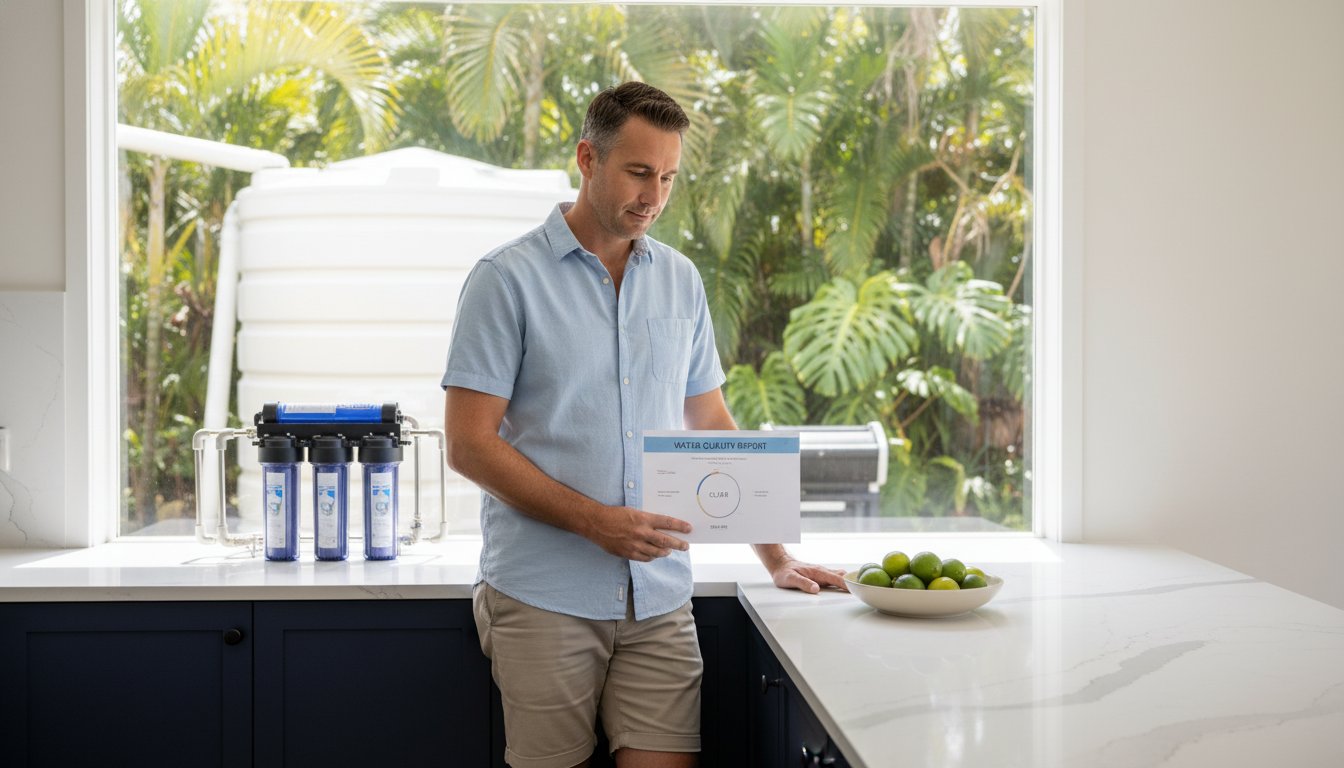
What to Do After Water Test Results: A Homeowner’s Guide to Next Steps
Does your water test report look more like a complex chemistry exam than a helpful guide for your family's health? You've taken the proactive step of testing your tank or bore water, but staring at rows of symbols and numbers like 0.01 mg/L for lead can be overwhelming. It's completely normal to feel uncertain about what to do after water test results arrive, especially when you're responsible for the safety of your household in areas like Doonan, Cooroy, or Tinbeerwah. At Sunshine Coast Water Testing, we provide the clarity you need because we believe that water testing identifies the problem — the solution comes next.
We agree that technical jargon shouldn't stand between you and total peace of mind. In this guide, you'll learn how to interpret your laboratory report and take the right actions to ensure your household water meets the Australian Drinking Water Guidelines. We'll explain what pH levels outside the 6.5 to 8.5 range actually mean for your plumbing and your health. If your report shows that your water does not meet Australian Drinking Water Guidelines and should be addressed, we'll show you how Pristine Water Systems Sunshine Coast can help with targeted filtration or UV purification. From the hinterland of Pomona to the coast at Noosa, here is your clear, prioritised path to better water quality.
Key Takeaways
- Learn how to decode technical lab symbols by comparing your results directly to the health and aesthetic benchmarks set by the Australian Drinking Water Guidelines.
- Discover exactly what to do after water test results arrive to protect your household, including how to prioritise health concerns over minor taste or staining issues.
- Get a clear explanation of how common contaminants like E. coli or acidic pH levels can impact your family's wellbeing and the lifespan of your appliances.
- Understand why a plain-English summary from Sunshine Coast Water Testing is the most efficient way to turn raw data into a practical action plan.
- Find out how to transition from identifying a problem to implementing a permanent fix with help from Pristine Water Systems Sunshine Coast.
Deciphering Your Report: Moving Beyond the Raw Lab Data
Getting a thick envelope or a detailed email from a lab can feel like receiving a message in a foreign language. You've done the right thing by testing your tank or bore water, but now you're faced with a wall of data. Knowing what to do after water test results land in your inbox starts with understanding how the information is presented. At Sunshine Coast Water Testing, we use NATA-accredited laboratories to process your samples. This ensures that every number on your page is backed by rigorous scientific standards and is legally robust, which is essential if you're using the data for property sales or local council compliance in areas like Doonan or Tinbeerwah.
What is a Certificate of Analysis (COA)?
The Certificate of Analysis, or COA, is the official document issued by the laboratory. It is a dense table that lists every substance tested, from heavy metals to bacteria. To read it correctly, look for the "Result" column and compare it to the "Guideline Value" column. These guideline values are based on established drinking water quality standards, such as the Australian Drinking Water Guidelines (ADWG). You'll also see "Units of Measure" like mg/L (milligrams per litre) or CFU/100mL (colony forming units). Another term you'll spot is the "Limit of Reporting" (LOR). This is simply the lowest level the lab equipment can reliably detect. If your result is "less than LOR", it means the substance wasn't found at a detectable level.
The Value of a Plain-English Summary
While the COA provides the raw data, it doesn't always tell you what that data means for your daily life in Cooroy or Pomona. This is where a professional water analysis summary becomes invaluable. A plain-English summary translates chemical symbols into real-world impacts. For example, instead of just seeing a low pH number, you'll understand that your water is acidic and might be corroding your copper pipes or staining your laundry. High turbidity isn't just a number; it's a sign that your filters might be clogging too quickly.
Professional interpretation prevents unnecessary anxiety over minor fluctuations that don't actually affect household safety. We believe that water testing identifies the problem, but the solution comes next. If your summary indicates that your water does not meet Australian Drinking Water Guidelines and should be addressed, you can confidently reach out to Pristine Water Systems Sunshine Coast to discuss specific filtration or UV purification options. This approach ensures you aren't just guessing what to do after water test results arrive; you're following a clear, expert-led roadmap for your home.
Benchmarking Against the ADWG: Identifying Health vs. Aesthetic Risks
The Australian Drinking Water Guidelines (ADWG) serve as the national roadmap for water quality. While these guidelines aren't legally enforceable for private systems, they are the essential benchmark used by Sunshine Coast Water Testing to help you decide what to do after water test results arrive. If you live in Noosa or Cooroy and rely on tank or bore water, you are essentially your own water utility manager. Understanding the difference between a health risk and an aesthetic issue is the first step toward managing your household supply effectively.
Health Guidelines: The Non-Negotiables
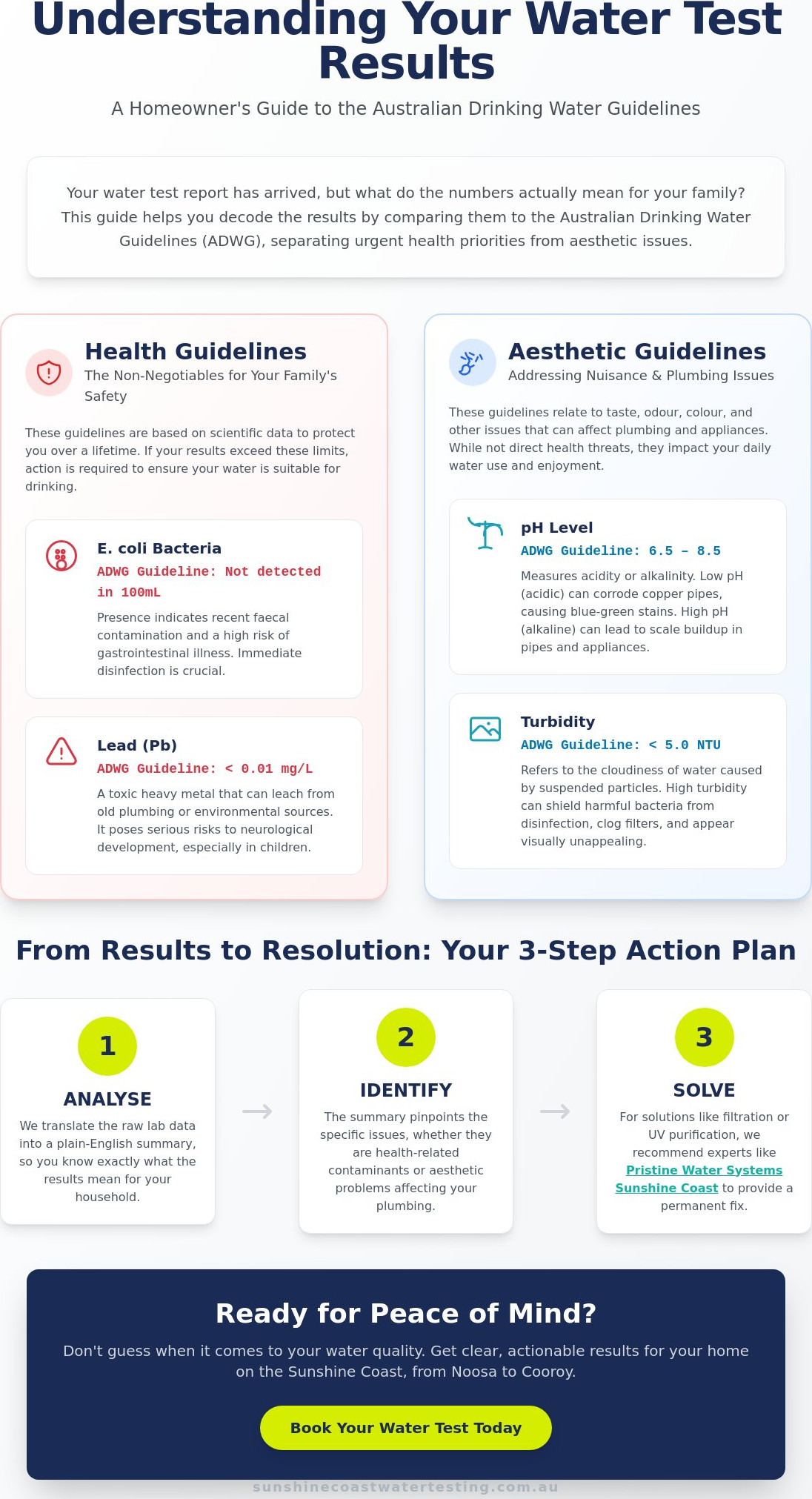
Health guidelines are established based on scientific research to protect people over a lifetime of consumption. Parameters like E. coli or heavy metals have very strict limits. For instance, the ADWG health-based guideline value for lead is 0.01 mg/L. If your report shows that your water does not meet Australian Drinking Water Guidelines and should be addressed due to microbiological or chemical levels, immediate action is required. You can find more detail in our Australian Drinking Water Guidelines for Private Sources guide. Testing identifies these invisible issues, allowing you to implement a targeted solution like a UV sterilisation system from Pristine Water Systems Sunshine Coast.
Aesthetic Guidelines: Taste, Colour, and Odour
Aesthetic guidelines focus on the look, taste, and smell of your water. While a result might exceed an aesthetic guideline, it doesn't necessarily mean there is a health risk. However, these issues often signal that your system needs maintenance. Common aesthetic parameters include:
- pH Levels: The ideal range is 6.5 to 8.5. Water outside this range can taste metallic or cause blue-green staining on your pipes and sinks.
- Iron and Manganese: These minerals are common in bore water around Pomona and can cause brown or black staining in your laundry.
- Hardness: High mineral content leads to scale build-up in hot water systems and makes it harder for soap to lather.
- Turbidity: This refers to the cloudiness of the water, which can interfere with disinfection processes.
Understanding these distinctions helps you prioritise your next steps. If you're unsure where your water sits on the scale, it's a good idea to book a water test to get a clear baseline for your property. Remember, knowing what to do after water test results are in your hands depends entirely on whether you're fixing a health concern or simply improving the daily experience of your water.
Common Contaminants Explained: What Your Results Mean for Your Household
Understanding the specific contaminants in your report is the key to deciding what to do after water test results arrive. While the numbers tell one story, the physical impact on your home tells another. Whether you're noticing blue-green stains in your bathtub in Doonan or finding that your tea tastes slightly metallic in Noosa, these are often direct results of the chemical or biological makeup of your water. We believe that water testing identifies the problem, but the solution comes next.
Bacterial Hits in Tank and Bore Water
For many households in the Sunshine Coast hinterland, rainwater tanks are the primary water source. It's common for birds, frogs, or leaf litter to introduce organic matter into these systems. If your report shows a "detect" result for E. coli, this is a clear signal that your water does not meet Australian Drinking Water Guidelines and should be addressed. Bacteria can often "hide" behind high turbidity, which is the technical term for cloudiness or suspended sediment. If your water is turbid, standard UV sterilisation might be less effective because the shadows cast by tiny particles can protect bacteria from the light. This is why a plain-English summary from Sunshine Coast Water Testing is so helpful; we explain how these results interact rather than just listing them in isolation.
Metals and Minerals: Plumbing and Appliances
Chemical properties like pH and hardness have a massive impact on the longevity of your home infrastructure. If your water has a low pH (below 6.5), it's considered acidic. This "hungry" water can actually eat away at your copper pipes, which is why you might see blue or green staining on white tiles. On the other hand, "hard" water contains high levels of calcium and magnesium. Over time, this builds up as scale inside your dishwasher, washing machine, and hot water service, significantly reducing their efficiency and lifespan. For those using bore water in areas like Pomona or Cooroy, you might also see high levels of iron or manganese, which cause stubborn brown or black staining.
- Heavy Metals: These can enter your supply through old brass fittings or environmental runoff. You can learn more about this in our guide on interpreting heavy metal water test results.
- Corrosion: Acidic water doesn't just stain; it can eventually lead to pinhole leaks in your plumbing.
- Sediment: High turbidity can clog tap aerators and damage ceramic cartridges in modern mixers.
Once you've identified these issues, the next step is implementation. Whether you need a specialised filter to balance pH or a system to remove heavy metals, Pristine Water Systems Sunshine Coast provides the practical hardware solutions to fix the issues our testing uncovers. This ensures your household water isn't just tested, but actively managed for the long term.
Immediate Safety Steps: What to Do When Guidelines Aren’t Met
What happens when your report confirms that your water quality isn't where it needs to be? Finding out that your supply does not meet Australian Drinking Water Guidelines and should be addressed can feel daunting, but having a structured plan removes the guesswork. Whether you are in Doonan or Cooroy, the protocol remains the same: Isolate, Treat, and Retest. We always remind our clients that water testing identifies the problem, but the solution comes next. This is why knowing what to do after water test results arrive is just as important as the test itself.
Your first priority is protecting the most vulnerable members of your household. Infants, the elderly, and those with compromised immune systems are more sensitive to fluctuations in water quality. If your plain-English summary from Sunshine Coast Water Testing highlights a health-based exceedance, you should immediately communicate these results to everyone in the home and follow the specific steps below to manage the situation while a permanent solution is organised.
Short-Term Fixes for Microbiological Contamination
If your results show a "detect" for E. coli or high coliform counts, you must act quickly to manage the biological risk. Start by bringing all water intended for drinking, food preparation, or teeth brushing to a rolling boil for at least one full minute. This simple step is highly effective at neutralising most pathogens. Alternatively, switch to a known safe source, such as bottled water, for all consumption needs. Once these immediate measures are in place, the next step is to address the source of the contamination. This often involves a professional tank clean or shock chlorination. Pristine Water Systems Sunshine Coast can assist with these services to restore your tank's health and clear out accumulated sediment where bacteria often thrive.
Managing Chemical or Metal Exceedances
It is a common myth that boiling water fixes everything. In reality, boiling does not remove chemicals or heavy metals; it can actually make the problem worse by evaporating the water and concentrating the remaining contaminants. If your report indicates high levels of lead, arsenic, or copper, you must isolate the affected taps. If the heavy metals are detected across the entire system, you should stop using the water for drinking and cooking immediately.
The key is identifying the source. Is the metal leaching from your home’s internal plumbing, or is it coming from the bore or tank itself? If you haven't yet identified the exact cause, you can book a water test specifically targeting heavy metals to pinpoint the entry point. Once the source is clear, you can implement the right filtration strategy to ensure your water meets the required standards for long-term safety. Understanding what to do after water test results show chemical issues ensures you don't waste time on ineffective treatments like boiling, moving you straight toward a permanent fix.
Bridging the Gap: Turning Your Results into a Long-Term Water Strategy
A water test report is a powerful diagnostic tool, but it is only the first half of the journey. Once you have received your plain-English summary, the focus shifts from identifying risks to implementing a permanent household solution. Understanding what to do after water test results arrive means moving beyond temporary measures like boiling water and investing in a system designed for your property's specific needs. Whether you are managing a rainwater tank in Tinbeerwah or a bore system in Pomona, a tailored strategy is the only way to ensure your supply consistently meets the Australian Drinking Water Guidelines.
Professional Solutions for Your Home
Raw laboratory data can be complex, and attempting a DIY filtration setup often leads to wasted money on ineffective equipment. The most reliable path is to hand your professional water analysis directly to a treatment specialist. This is where the partnership between testing and remediation becomes vital. We recommend sharing your results with Pristine Water Systems Sunshine Coast, as they can use our specific findings to recommend the right hardware. Their team specialises in tank cleaning and UV purification, ensuring that if your water does not meet Australian Drinking Water Guidelines and should be addressed, the fix is targeted and effective. Filtration systems should never be "off the shelf"; they must be customised to neutralise the exact levels of minerals or bacteria identified in your report.
The Path to Peace of Mind
Choosing a professional installation is about more than just convenience; it is about maintaining the integrity of your water safety. A specialist ensures that UV lamps are correctly positioned, filters are the right micron size for your turbidity levels, and pH correction units are calibrated properly. However, even the best system requires ongoing attention. Environmental factors on the Sunshine Coast, such as heavy seasonal rain in Noosa or shifting groundwater levels in Cooroy, can change your water chemistry over time. We encourage homeowners to avoid the "set and forget" trap, which can leave your family vulnerable if a component fails or source water quality shifts.
To maintain total confidence in your tap water, establish a regular testing schedule. We suggest an annual health check for tanks and bi-annual testing for bore water supplies. This proactive approach ensures your treatment system is still performing as intended. If you have recently installed a new filtration system or completed a major tank clean, the final step in your strategy should be to book a follow-up water test. This confirms that the remediation was successful and that your household water is now safely within the recommended guidelines. Remember, water testing identifies the problem — the solution comes next, and consistent monitoring keeps that solution working.
Take Control of Your Household Water Quality
Navigating what to do after water test results arrive doesn't have to be a solo journey when you have the right local experts by your side. By understanding the difference between health and aesthetic risks, you can prioritise the most critical actions for your family in Noosa, Cooroy, or Doonan. Whether you are dealing with bacterial hits in your tank or acidic bore water that is corroding your pipes, the path forward is always the same: test, treat, and maintain. Testing identifies the problem, but the solution ensures your peace of mind.
As a trusted national provider of water safety assessments, we ensure every sample undergoes NATA-accredited laboratory analysis. We pride ourselves on the qualitative value of our reporting; plain-English summaries are included with every report to translate scientific data into practical household steps. Once the testing identifies the issue, you can confidently turn to professional partners like Pristine Water Systems Sunshine Coast to implement a permanent solution tailored to your specific results.
Ready to clear up the confusion? Book a professional water test with a plain-English summary today. Take the first step toward total clarity and safety for your home.
Frequently Asked Questions
My water test says E. coli was detected. Is it safe to shower?
Yes, it's generally safe to shower if E. coli is detected, provided you don't swallow the water. However, people with open wounds or weakened immune systems should take extra care as bacteria can cause infections. Testing identifies the problem, but for a permanent fix, you might consider a UV system from Pristine Water Systems Sunshine Coast to ensure your supply meets the Australian Drinking Water Guidelines.
What does "mg/L" mean in my water quality report?
"mg/L" stands for milligrams per litre, which is the standard unit used to measure the concentration of minerals or chemicals in your water. It tells you exactly how much of a substance is dissolved in one litre of liquid. This unit is essential for understanding what to do after water test results arrive, as it allows you to compare your findings directly to the health and aesthetic limits set by the ADWG.
Can I just use a jug filter if my results show high heavy metals?
Most standard jug filters are designed to improve taste and odour rather than remove dissolved heavy metals like lead or arsenic effectively. If your report shows that your water does not meet Australian Drinking Water Guidelines and should be addressed due to metal levels, a jug filter is rarely a sufficient solution. You'll likely require a specialised filtration system installed at the point of entry to your home to ensure all taps are protected.
How often should I test my tank water if the first result was clear?
We recommend testing your rainwater tank at least once a year, even if your previous results were clear. Environmental factors like bird droppings, leaf litter, or heavy rain in areas like Cooroy and Doonan can change your water quality quickly. For bore water, a comprehensive test every two years is a good rule of thumb to monitor for shifting mineral levels or environmental runoff.
My water tastes fine, but the report says it doesn’t meet guidelines. Why?
Many contaminants that cause water to fall outside the national guidelines are completely tasteless, odourless, and invisible. For example, lead and E. coli don't change the flavour of your water but still require attention. Sunshine Coast Water Testing provides plain-English summaries precisely because your senses aren't enough to determine if your water is truly safe for your family.
What is the difference between a "detect" and a "non-detect" result?
A "detect" result means the laboratory found the substance in your sample at a level higher than their equipment's minimum detection limit. A "non-detect" means the substance was either completely absent or present in such a tiny amount that it couldn't be measured. This distinction is vital when deciding what to do after water test results show traces of chemicals or bacteria in your tank or bore.
Should I boil my water if the report shows high lead levels?
No, you should never boil your water to remove lead or other heavy metals. Boiling only kills bacteria; it actually concentrates metals by evaporating some of the water and leaving the lead behind. If lead is detected, the best approach is to isolate the source and consult a specialist like Pristine Water Systems Sunshine Coast for a proper filtration solution that removes the metal entirely.
How long does it take to get results after I send my sample?
Most homeowners receive their Certificate of Analysis and plain-English summary within 5 to 10 business days after the lab receives the sample. This timeframe ensures the NATA-accredited laboratory can perform a thorough analysis of all parameters, from microbiological hits to heavy metal concentrations. We prioritise speed without compromising the scientific accuracy you need for total peace of mind.

Article by
Stephen McDougall
Stephen McDougall is the owner of Pristine Water Systems Sunshine Coast and Sunshine Coast Water Testing, specialising in water quality, filtration, and tank systems. He is known for delivering clear, easy-to-understand advice and practical solutions to help clients maintain safe, reliable water.
Disclaimer
The information provided in this article is for general guidance only and is not a substitute for professional water testing or site-specific advice. Water quality can vary between properties. For accurate results and recommendations, we recommend professional testing and assessment.