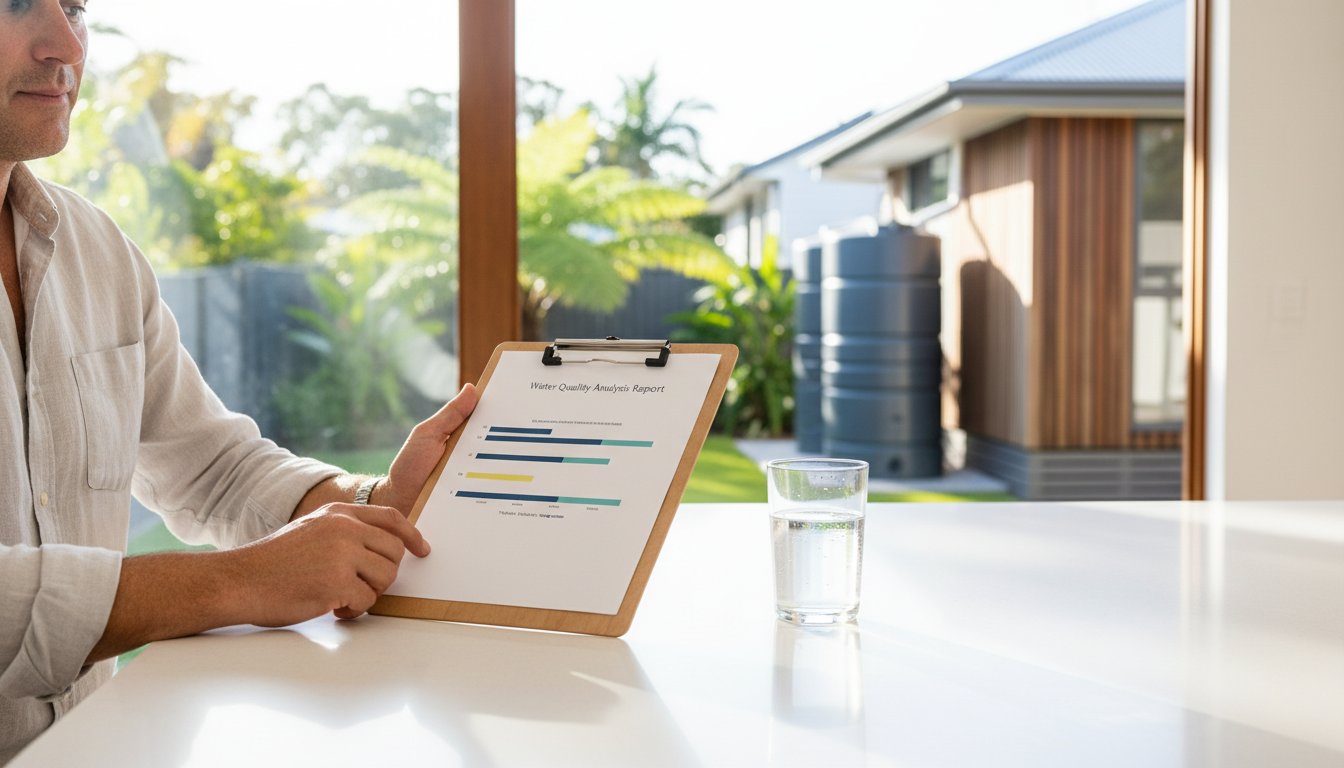
Interpreting Heavy Metal Water Test Results: A 2026 Homeowner’s Guide
Have you ever stared at a water analysis report and felt like you needed a chemistry degree just to understand if your morning cuppa was okay? It's completely normal to feel a bit lost when faced with technical units like mg/L or µg/L, particularly when you're concerned about the long-term health of your household in Noosa or Cooroy. We agree that your peace of mind shouldn't be buried under lab jargon. That's why interpreting heavy metal water test results is about more than just reading numbers; it's about knowing exactly how your tank or bore water measures up against the latest Australian Drinking Water Guidelines (ADWG).
In this guide, you'll learn how to decode your lab report and identify whether levels of lead, manganese, or nickel are within safe benchmarks. We'll explain the difference between metals that simply stain your laundry and those that don't meet ADWG standards and should be addressed. At Sunshine Coast Water Testing, we believe that testing identifies the problem, but the solution comes next. If your results show an issue, we'll show you how Pristine Water Systems Sunshine Coast can help with targeted filtration or tank cleaning to restore your water quality in areas like Doonan, Pomona, and Tinbeerwah.
Key Takeaways
- Learn how to compare your specific lab data against the Australian Drinking Water Guidelines (ADWG) to see if your water quality should be addressed.
- Understand the nuances of interpreting heavy metal water test results by distinguishing between health-related concerns and aesthetic issues like staining or metallic tastes.
- Determine if metals like lead or copper are coming from your bore or tank source or leaching from older household plumbing and brass fittings.
- Discover why simple boiling won't remove heavy metals and how professional filtration systems provide a practical path to better water quality.
- Follow our clear next steps: testing identifies the issue through Sunshine Coast Water Testing, while Pristine Water Systems Sunshine Coast provides the solution.
Understanding Your Heavy Metal Water Report and the ADWG
Heavy metal water testing is a precise laboratory analysis. It looks for elements like lead, arsenic, and copper that can accumulate in your body over time. Many of these toxic heavy metals are entirely invisible. They don't have a scent. They don't change the water's taste. This makes testing the only reliable way to 'see' chemical hazards in your supply. It's especially important for those using bore water or older tank systems in Pomona and Doonan.
The Australian Drinking Water Guidelines (ADWG) serve as our national benchmark for safety. These guidelines tell us which levels are acceptable and which might require action. However, interpreting heavy metal water test results isn't always straightforward for a homeowner. A lab report can feel overwhelming without a bit of context. We always remind our clients that water testing identifies the problem; the solution comes next. Once you know what's in your water, you can take practical steps to fix it.
Decoding the Units: mg/L vs. µg/L
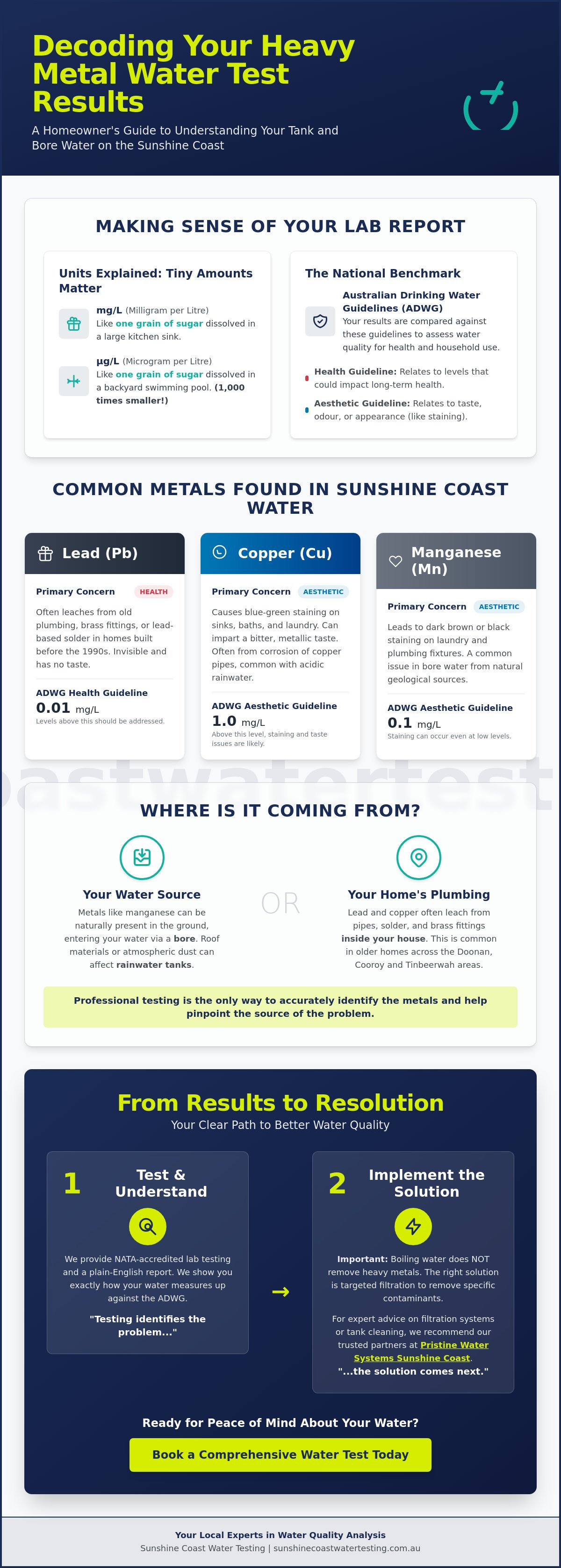
Most reports measure metals in milligrams per litre (mg/L) or micrograms per litre (µg/L). To put this in perspective, think of a single grain of sugar. One mg/L is like that grain of sugar in a large kitchen sink. One µg/L is far smaller; it's like that same grain of sugar dissolved in a backyard swimming pool. These tiny amounts matter because some metals are potent even at low concentrations.
When you look at your document, check the 'LOR' or Limit of Reporting. This is the lowest amount the laboratory equipment can detect. If your result is listed as 'less than LOR', the metal wasn't found at a level the machine could measure. It's a good sign, but it's just one piece of the puzzle.
The Role of NATA Accredited Laboratories
You can find DIY test strips at many shops, but they aren't accurate enough for heavy metals. They often miss low-level contamination that still falls outside the ADWG. Professional analysis through Sunshine Coast Water Testing provides a much higher level of certainty. We use NATA accredited labs because they meet strict national standards for scientific rigour.
The results from these labs are legally and scientifically robust. Instead of leaving you with a confusing spreadsheet, we provide plain-English summaries. This helps you understand if your water does not meet Australian Drinking Water Guidelines and should be addressed. If we find an issue, Pristine Water Systems Sunshine Coast can step in with professional filtration or tank cleaning. Testing gives you the facts, and the right equipment provides the cure.
Common Heavy Metals Found in Australian Water Supplies
While some metals occur naturally in the earth, others find their way into your glass through aging infrastructure or local land use. When interpreting heavy metal water test results, it helps to understand that a 'high' reading doesn't always mean your source is contaminated. Often, the issue is much closer to home. In areas like Noosa and Cooroy, we frequently see results influenced by the age of the house or the specific geology of a bore site. Identifying the specific metal is the first step in deciding how to manage your water quality.
Lead remains a primary concern for many homeowners, particularly in houses built before the 1990s. It rarely comes from the main water supply; instead, it typically leaches from brass fittings or lead-based solder in your own plumbing. Copper is another frequent find. If you've noticed blue-green staining on your baths or basins, it's a tell-tale sign of copper leaching. While copper is an essential nutrient in tiny amounts, levels that exceed the Australian Drinking Water Guidelines (ADWG) can cause a bitter taste and should be addressed to prevent plumbing damage.
Lead and Copper: The Plumbing Connection
The chemistry of your water plays a massive role in how it interacts with your pipes. 'Soft' water, which is common in rainwater tanks, can be quite corrosive because it lacks minerals. This acidity allows the water to slowly eat away at metal pipes and fittings. To figure out if your plumbing is the culprit, we look at 'first-draw' versus 'flushed' samples. If the metal levels drop after running the tap for a minute, the problem is likely your household pipes. For a deeper look at this, you can read our guide on assessing old pipes for lead contamination.
Arsenic and Cadmium: Environmental and Agricultural Risks
For those using bore water in Pomona or Tinbeerwah, the risks are often geological. Arsenic can occur naturally in groundwater as it moves through certain rock formations. It's invisible and tasteless, making professional lab analysis vital. Cadmium is another metal we watch for, as it can sometimes enter rural water supplies through historical use of specific phosphate fertilisers. If you are on a rural block, our guide on testing for agricultural runoff in bore water provides more specific advice for your situation.
Sunshine Coast Water Testing provides the clear, plain-English summaries you need to make sense of these findings. We believe that testing identifies the problem, but the solution comes next. If your report shows that your water quality should be addressed, Pristine Water Systems Sunshine Coast offers targeted solutions like specialised filtration or tank cleaning to get your system back on track. A great way to start is to book a standard drinking water test to see exactly what's in your supply.
Health Risks vs. Aesthetic Quality: How to Prioritise Results
When you are interpreting heavy metal water test results, it is vital to understand that the Australian Drinking Water Guidelines (ADWG) categorise metals into two distinct groups: health-based and aesthetic. Not every high number on your report requires the same level of urgency. Some metals are regulated because of their potential for long-term health impacts, while others are monitored because they make your water look, smell, or taste unpleasant. Knowing the difference helps you decide which issues to tackle first for your Sunshine Coast home.
Even if a metal is listed under an aesthetic limit, it can still cause significant headaches for a homeowner. For example, high levels of certain minerals can lead to scale build-up in your hot water system or corrode the internal components of your dishwasher and washing machine. While these results might not suggest a direct health risk, they can certainly lead to expensive appliance repairs. At Sunshine Coast Water Testing, we provide a plain-English summary that clearly distinguishes between these two categories, so you aren't left guessing about your water's quality.
Health-Based Targets: Lead, Arsenic, and Nickel
Health-based guidelines are set to protect people over a lifetime of consumption. Metals like lead, arsenic, and nickel have very low thresholds because they can have chronic effects if consumed regularly. If your laboratory report shows that any of these elements exceed the ADWG limit, the water does not meet Australian Drinking Water Guidelines and should be addressed promptly. This is especially critical for families in Noosa or Cooroy with infants, young children, or immunocompromised members, as they can be more sensitive to these contaminants. A health-related exceedance is always a priority and requires a professional solution to ensure the water is suitable for household use.
Aesthetic Targets: Iron, Zinc, and Manganese
Aesthetic limits are more about the 'usability' of your water. High iron or manganese levels are common in bore water and are easily spotted by the orange or black staining they leave on laundry, toilets, and tiles. They also give the water a distinct metallic tang. Zinc is another metal often found in rainwater tanks; while not toxic at typical levels, it can give water a greasy appearance or a dry, chalky mouthfeel. While these don't necessarily mean the water is a health hazard, they are usually the main reason homeowners seek out filtration.
Our core philosophy is simple: water testing identifies the problem, but the solution comes next. Once your report has highlighted exactly which metals are present, Pristine Water Systems Sunshine Coast can provide the necessary filtration or purification systems to fix the issue. Whether it's a health-based concern or an annoying stain on your porcelain, getting the right data is the only way to move forward with confidence.
Actionable Steps After Receiving Your Test Results
Once your lab report arrives, the process of interpreting heavy metal water test results moves from curiosity to action. It's easy to get overwhelmed by rows of data, but a structured approach ensures you focus on what actually matters for your household. We recommend following these four steps to turn your data into a clear plan for your home in Noosa or Cooroy.
- Step 1: Compare your results. Look at the summary provided in your report. Sunshine Coast Water Testing includes a plain-English comparison against the Australian Drinking Water Guidelines (ADWG) so you can instantly see which levels are within the green zone.
- Step 2: Pinpoint the cause. Is the contamination coming from your source or your house? If you're in Pomona or Tinbeerwah using a bore, the issue might be geological. If you're in an older home, it could be your pipes.
- Step 3: Consult an expert. Don't try to guess the real-life impact. A professional summary helps you understand if a specific result affects your health or just the lifespan of your dishwasher.
- Step 4: Implement a fix. Remember our core message: water testing identifies the problem; the solution comes next. Whether it's a specialized filter or a tank clean, you now have the facts to choose the right fix.
Interpreting the "Detection Limit" and "Exceedance"
On your Certificate of Analysis, you'll often see the term "ND", which stands for Not Detected. This is the ideal result for heavy metals, meaning the lab equipment found nothing above its minimum reporting level. If a metal is "detected" but the number is lower than the ADWG limit, it's generally considered acceptable for daily use. However, if the number is higher than the guideline, it's called an exceedance. This indicates that your water quality does not meet Australian Drinking Water Guidelines and should be addressed. If you haven't established a baseline for your property yet, you should book a water test to get an accurate professional report.
From Detection to Correction
Identifying a heavy metal exceedance isn't a reason to panic, but it is a reason to act. Because metals like lead or arsenic can't be boiled away, you need a physical or chemical barrier to remove them. This is where professional remediation becomes essential. Sunshine Coast Water Testing provides the data you need to prove there's an issue, and Pristine Water Systems Sunshine Coast provides the specialized filtration or purification systems to resolve it. Moving from a lab report to a clean tap is a straightforward process when you have the right local partners helping you navigate the technical details.
Professional Solutions for Heavy Metal Contamination
A common misconception among homeowners is that boiling water makes it safe from all contaminants. While boiling is effective against most bacteria, it does absolutely nothing to remove heavy metals. In fact, boiling can actually concentrate metals like lead or arsenic because as the water evaporates, the mineral content remains behind in a smaller volume of liquid. When interpreting heavy metal water test results, it's clear that physical removal through specialised filtration is the only reliable way to manage these elements.
Managing high-mineral bore water in areas like Noosa and Cooroy requires more than a one-size-fits-all approach. Because every property has a unique chemical profile, the solution must be tailored to the specific metals identified in your lab report. Sunshine Coast Water Testing provides the data, and we recommend Pristine Water Systems Sunshine Coast as the trusted local partner to implement the fix. They understand the regional water challenges and provide the heavy-duty systems needed to bring your water back in line with national standards.
Why DIY Solutions Often Fail
Simple jug filters or basic fridge dispensers are often insufficient for significant heavy metal exceedances. These systems are designed to improve taste by removing chlorine, but they rarely have the capacity to trap microscopic metal ions effectively. If your report also shows microbiological issues alongside metals, you may need UV purification to ensure a comprehensive result. For those on tank water, a holistic approach is best; you can refer to our 2026 health check guide for rainwater tanks to see how maintenance and testing work together.
Implementing a Permanent Fix
Understanding the technical data is just the beginning; interpreting heavy metal water test results correctly allows you to invest in the right technology rather than guessing with ineffective hardware. For results that do not meet ADWG, a tailored filtration system like Reverse Osmosis (RO) or high-grade Activated Carbon is the best path forward. Reverse Osmosis is particularly effective as it forces water through a semi-permeable membrane, leaving up to 99% of dissolved metals behind.
To ensure your system is correctly installed, Pristine Water Systems Sunshine Coast can provide effective filtration and UV sterilisation solutions. Once your new system is in place, regular re-testing is the final step. This ensures your filters are performing as expected and provides the ongoing peace of mind that your household water remains of the highest quality. Testing identifies the issue, professional systems fix it, and re-testing confirms your family's safety.
Taking Control of Your Home’s Water Quality
Understanding what is in your glass shouldn't be a guessing game. As we've explored, interpreting heavy metal water test results is the essential first step to ensuring your household supply aligns with the Australian Drinking Water Guidelines. Whether you're dealing with blue-green staining from copper pipes or invisible minerals in a new bore, having the right data allows you to make informed decisions for your family's well-being.
At Sunshine Coast Water Testing, we bridge the gap between complex science and practical home maintenance. Our professional NATA-accredited laboratory analysis includes detailed ADWG comparisons and practical recommendations specifically for homeowners in Noosa, Doonan, and across the coast. Remember that water testing identifies the problem: the solution comes next. If your results show an exceedance, Pristine Water Systems Sunshine Coast can provide the specialised filtration needed to restore your water quality. Don't let confusing units hold you back from peace of mind. Get a professional, plain-English summary of your water quality today. We're here to help you move forward with confidence and clarity.
Frequently Asked Questions
Can I tell if there are heavy metals in my water by the taste?
You generally cannot taste or smell heavy metals like lead or arsenic, which makes them difficult to detect without a laboratory analysis. While high levels of copper might leave a bitter, metallic tang and iron can taste rusty, many of the most concerning elements are completely invisible to your senses. Professional testing is the only reliable way to confirm exactly what is in your household supply.
What should I do if my lead levels exceed the Australian Drinking Water Guidelines?
If your results show lead levels above 0.01 mg/L, the water does not meet Australian Drinking Water Guidelines and should be addressed. You should first identify if the lead is leaching from older brass fittings or lead solder in your home's plumbing. While you wait for a permanent filtration fix from Pristine Water Systems Sunshine Coast, avoid using the first-draw water for drinking or cooking.
Is tank water more likely to have heavy metals than mains water?
Tank water isn't inherently more prone to heavy metals, but it is susceptible to local environmental factors that mains water isn't. Dust from industrial areas or lead flashing on older roofs in Noosa or Cooroy can wash into your tank during heavy rain. Because tank water is often slightly acidic, it can also leach metals from your home's internal pipes more easily than treated town water.
How often should I test my bore water for heavy metals?
We recommend testing your bore water at least once a year or whenever you notice a change in colour, taste, or odour. Groundwater chemistry can shift due to seasonal changes or local agricultural activity in areas like Pomona and Tinbeerwah. Regular monitoring ensures you are always accurately interpreting heavy metal water test results and that any installed filtration system is still performing its job effectively.
Does boiling water remove lead or arsenic?
No, boiling water does not remove lead, arsenic, or other heavy metals. Because metals don't evaporate, boiling actually reduces the total volume of water while the metals stay behind, which increases their concentration in the pot. If your report shows an exceedance, you need a physical removal method like a specialised filter or a reverse osmosis system rather than heat to make the water safe.
What is the difference between a health limit and an aesthetic limit in water testing?
A health limit is a strict safety benchmark designed to prevent illness from long-term exposure to elements like nickel or cadmium. An aesthetic limit refers to characteristics that affect the water's appearance, taste, or smell, such as iron staining your laundry. While aesthetic issues are annoying and can damage your appliances over time, they don't carry the same immediate health implications as a health-based exceedance.
Are heavy metals in water dangerous for pets and livestock?
Yes, pets and livestock can be affected by heavy metals just like humans. Animals often consume more water relative to their body weight, meaning they can be sensitive to elements like lead or arsenic over time. If your household water does not meet Australian Drinking Water Guidelines and should be addressed, it is a wise precaution to provide the same filtered water to your animals and pets.
How much water do I need to provide for a heavy metal lab test?
Most heavy metal analyses require a 250ml to 500ml sample collected in a specific, lab-supplied bottle. The exact volume depends on whether you are also testing for other minerals or bacteria at the same time. Sunshine Coast Water Testing provides the correct containers and instructions to ensure your sample isn't contaminated during collection, which is vital for accurately interpreting heavy metal water test results.

Article by
Stephen McDougall
Stephen McDougall is the owner of Pristine Water Systems Sunshine Coast and Sunshine Coast Water Testing, specialising in water quality, filtration, and tank systems. He is known for delivering clear, easy-to-understand advice and practical solutions to help clients maintain safe, reliable water.
Disclaimer
The information provided in this article is for general guidance only and is not a substitute for professional water testing or site-specific advice. Water quality can vary between properties. For accurate results and recommendations, we recommend professional testing and assessment.